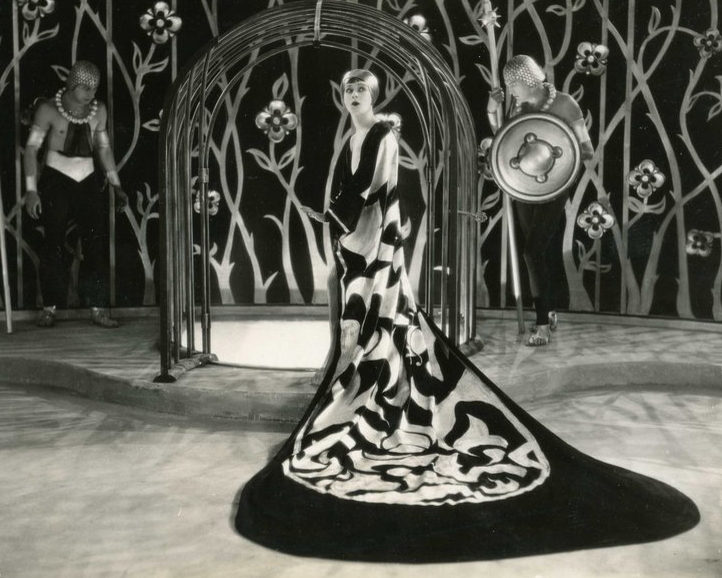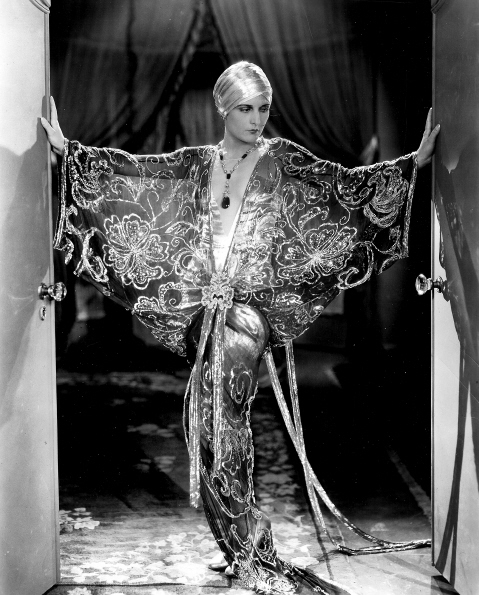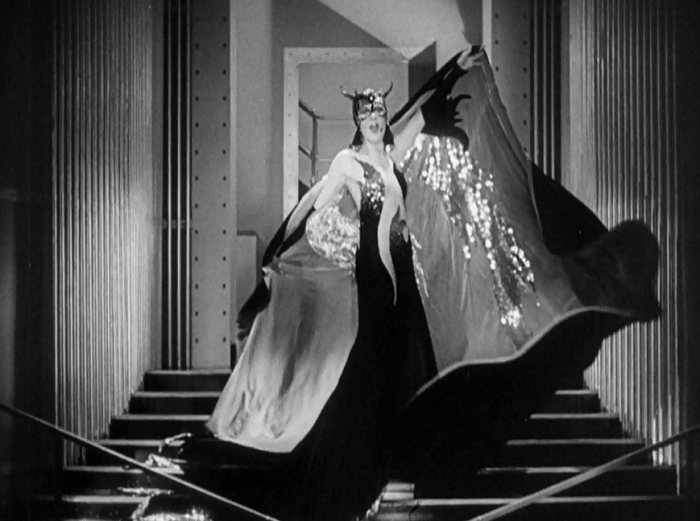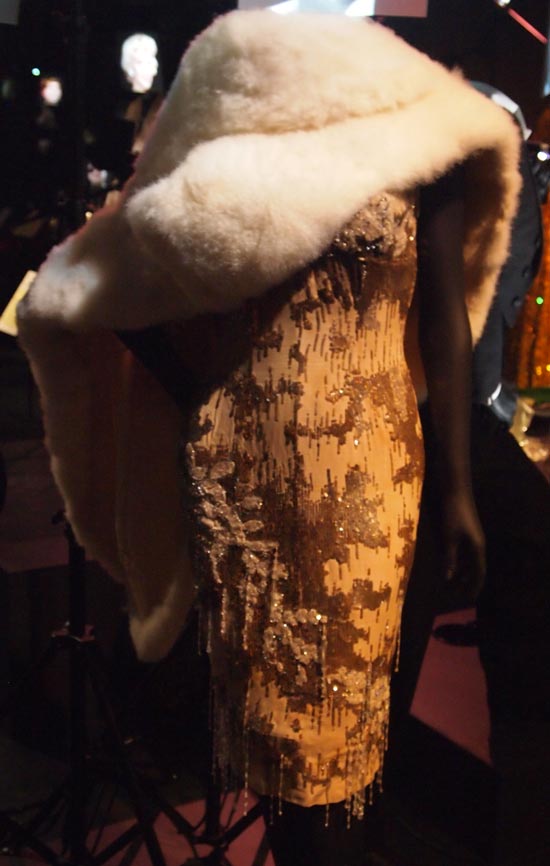
COSTUMES FROM THE GOLDEN AGE OF HOLLYWOOD EXHIBITION

The Museum of Brisbane in Australia recently completed a hugely popular exhibition based on the Nicholas Inglis collection, Costumes from the Golden Age of Hollywood. As its title denotes, it was devoted to the costumes designed and worn on the screen during Hollywood’s Golden Age of film, from the 1920s through the 1960s. The exhibition ran from November 2014 through May 2015.  Over 200,000 people visited the exhibition, one of the most ambitious the Museum of Brisbane ever held. To say the least, Nicholas Inglis is a passionate classic film fan and serious, even fanatic, classic film costume collector. The fortuitous story of how the Museum and the Collector collaborated (although they were in the same city these things do not just happen in museums), is told in this interview.  The exhibition was initiated by Museum Deputy Director Christopher Salter when he approached Nicholas Inglis about a possible exhibition, which started a three year project, which also involved co-curator Dr. Nadia Buick.  I recently spoke with Nicholas about the exhibition and asked him for an interview for the Silver Screen Modes. Nick and I have been communicating long distance for many years over the subject of classic Hollywood costume design and designers, and have both been collecting in that field. I also had the privilege of writing an essay for the catalogue of the exhibition, which completely sold out. Here is Nick’s interview, along with a sampling of his own photos. Many more can be found at Nick’s own blog The Vintage Film Costume Collector

Nick Collection Photo 1
Nicholas Inglis poses in front of his costumes at the exhibition

What is it about the Golden Age of Hollywood that appeals to you so much?

I have always had a love for the film classics of the 30’s and 40’s and 50’s. As a teenager I used to write to the performers for autographs. I also grew up watching the film classics. My Aunt owned the Dawn theatre at Chermside (Brisbane) so I got to watch some amazing films there as well. For me the Golden Age of Hollywood represents a time in movie making that no longer exists, a time when movies were special, they were an event for those going to the movies and were made with performers who were stars in every sense of the word. It was also a time in movie making when the quality of the talent both on screen and behind were at the best and when the studios had the resources to  make films that were the best of their kind and indeed that today continue to be seen and enjoyed.

Nick Collection Photo 4 jpg

There were 69 pieces are on exhibit as part of the exhibition at the Museum of Brisbane. How many pieces do you actually own?

There were 300 costume pieces in the collection. I have never really stopped to count them and it was only during this process of bringing the collection out to display that the whole collection was catalogued in such a way that it was counted and documented. The collection also includes stage worn pieces, posters, autographs and other film related memorabilia.

Is it difficult to maintain a collection of that size?

The costumes are stored in a facility, in acid free boxes and tissue paper. They are reclined to give them the best chance of survival. Being fabrics they do have a shelf life so it is important to ensure you are doing everything you can for them in terms of their ongoing survival.  Luckily you can also fit a number of costumes in a storage box thanks to their being fabrics and can be layered. They are not stored on mannequins.


Nick Collection Photo 6 jpg

Do you intend to extend your collection beyond the Golden Age of Hollywood?

I have collected and purchased from what could be described as more modern day films. I really only venture into that side of things if it is a film I have loved or have enjoyed a great deal. I have costumes worn by Bernadette Peters and Aileen Quinn from the film “Annie” and I have pieces worn by Robin Williams and Nathan Lane from “The Birdcage”. I also have a Nicole Kidman period costume from ‘Portrait of A Lady”. I am happy to say that I also have costumes from an modern day Australian classic with a trio of costumes worn by the main stars in the film ‘The Adventures of Priscilla, Queen of the Desert”. So really for me sometimes it is a matter of I don’t know what I may want to add to the collection until I have seen it!


Nick Collection Photo 7 jpg


How much involvement did you have in selecting the pieces shown for the exhibition?

When the museum approached me, they asked to see all the pieces that made up the collection. From there they then went away and put together a proposal of pieces that represented the story of not only my collection and how it came to be here in Brisbane but also in relation to the history of film in the Golden Age as well as the costumes which made this era so fascinating. I did hint a number of times in relation to the pieces which were perhaps favourites and they were included in the exhibit. It was a wonderful selection of pieces from my collection and the museum and the curators Christopher Salter and Nadia Buick have done an amazing job in putting together this feast for the senses.

What did you want people to get out of seeing the exhibition?

I wanted people to see not only the great craftsmanship and talent that went into the making of the costumes that were used during this era, but also to give people an understanding of what it was to be a star in the Golden Age of Hollywood and how the studios spared no expense in terms of creating these treasures for the screen.  Coming up close to the pieces you also get an idea of the detail and time that it would have taken to put these pieces together and only to be seen on screen sometimes for just a few minutes. I am also happy to say that visitors to the exhibition have also gone away wanting to connect with some of the films that are represented so hopefully I am sparking a whole new generation of people wanting to see and enjoy some of these great films.


Nick Collection Photo 9 jpg
Travis Banton designed costume for Claudette Colbert in CLeopatra, 1934

Was it difficult to choose which ones you would include and which ones you wouldn’t?

It was at first difficult knowing that only a limited number of pieces would be in the exhibition but it was really never the case that they could all be. There was just too much to show. The museum did have trouble in choosing what would go in for that very same reason, that there was so much too choose from. Some amazing pieces didn’t make the cut but hopefully that will be for another exhibition. What was used for the exhibit was a wonderful selection and representation of my collection.

You’ve been collecting since 1995. Have you ever missed out on a piece you particularly wanted?

Yes and it happens quite a lot. There are dedicated auction and houses around the world that specialize in entertainment memorabilia and when the auctions or sales come along, pieces are highly sought after and in demand. I have missed out on a many a piece over the years. There is one piece in the exhibition for example, a Carmen Miranda costume from the film ‘Nancy Goes to Rio’ and made at MGM studios in 1950. I had to bid on the piece three times over a number of years and at three different auctions until I was able to acquire it. So third time lucky!

Nick Inglis Hayward Smash Up
The smashing outfit was designed by Travis Banton for Susan Hayward in Smash-Up: the Story of a Woman.

You have various pieces from particular actresses such as Debbie Reynolds and Elizabeth Taylor. Is there a particular actor or designer you are drawn to when hunting new pieces?

When you are collecting for a number of years, you do eventually start to step back and ask what is it that you are missing or what is it that would you like. There are a number of performers that I am still searching for, a Marlene Dietrich costume piece for example. I seem to be drawn to some performers more than others and do have multiple costumes from stars such as Elizabeth Taylor, Lana Turner, Susan Hayward and Maureen O’Hara. I expect there is something about them as performers that drives me to add pieces from their films.

If I was to mention a designer, Walter Plunkett is a favourite. He designed for some film classics including ‘Gone with the Wind’ and ‘Singin in the Rain’. He was the best of the best when it came to period design in film which is an area of film making that I love. There are a number of pieces in the exhibit designed by Plunkett including an amazing period gown worn by Lana Turner in the MGM film ‘Diane’ and a Katharine Hepburn costume from the original film version of ‘Little Women’  made in 1933 at RKO studios.

Nick Collection Photo 8 jpg
Walter Plunkett design for Elizabeth Taylor in Raintree County, 1957


Nick Collection Photo 13 jpg
Walter Plunkett design for Lana Turner in Diane, 1956


Nick Collection Photo 17
Walter Plunkett design for Katharine Hepburn in Little Women, 1933

What’s the most expensive piece you’ve ever bought?

I have been a very lucky collector when it comes to being in the right place at the right time. I have bought from private collectors and have found items on auction sites such as eBay. A pair of boots for example worn by Judy Garland and made for her role as Annie Oakely in ‘Annie Get Your Gun’ 1950 were on display and were an eBay purchase. I picked them up for $200. I also have a photo of Judy Garland wearing the boots which were also on display. So it is really a matter of looking for those hidden treasures!

Have you ever bought something sight unseen and it’s turned out to be a complete disappointment? 

Quite often the pieces you are buying have had a number of lives, some can be as old at 80! And where the have been or where they have been stored since leaving the studios is seen in terms of their state today. They do come torn, altered, dirty, discoloured, or even as has happened on some occasions, literally falling apart in your hands. The thing about costumes is that they were made for a limited purpose, to be seen on screen for a short period of time and for the actor to perform their role. After that the costumes went back into storage to be used again on another actor, or redesigned or resized for alternate use. Costumes have been stored in attics, been hanging on hangers for 50 or more years, and have time has taken its toll. It is only in the past 40 years really that collectors have seen the need to preserve as much as is possible of what has remained of this film history.

Nick Collection Photo 12 jpg
Adrian design for the film Marie Antoinette

What are some of your favorite pieces from your collection?

I have always had difficulties answering that one. It is hard to pick a favorite. I do have favorite genres such as the movie musicals or the period films so I drawn to those and you can see that from the exhibit. I do have a Barbra Streisand piece as worn in the film ‘Funny Girl’ which I love for a number of reasons including that it is a film favourite, that it just looks amazing, and that it came from Ms Streisand herself. There are occasions when performers are able to retain pieces from their films and Barbra did just that. It is great to have that history trail to go wit the piece. The piece is also in the exhibition.

How do you acquire pieces for your collection?

See above re: the auction houses, internet auction sites, from other collectors and people who were at the original film studio auctions.

Nick Collection Photo 11 jpg

What happens to the collection when it’s not on exhibit?

When not on show, the items are in storage, preserved and protected from the elements, and until they can come out again and to be enjoyed.

Since the Exhibition has finished at the Museum of Brisbane. Do you intend to show it elsewhere?

I would dearly love to continue this journey of displaying pieces for the public to enjoy so I am hoping that museums across the country not only get to see the exhibition but also hopefully take an interest in displaying these amazing pieces of Hollywood history. The exhibit has been very successful with over 200,000 visitors to the exhibit since it opened in late November 2014. It is wonderful to see so much interest in the collection!

Nick Collection Photo 10jpg
Helen Rose design for Lucille Ball in The Long Long Trailer, 1953


What are some of the pieces you own that people didn’t get to see in the exhibition?

Some other pieces that are not in the exhibition include a Mae West period gown designed by Travis Banton and worn in her 1934 film ‘Belle of the Nineties’. Another rare piece is a costume worn by Theda Bara in the 1917 silent version of the film ‘Cleopatra’. The film itself is now considered lost however it is amazing for me that the piece survives and that I have been able to find so many photos of the costume being worn by Theda Bara. There is certainly enough pieces for further exhibitions and a few times over! There is also so much in terms of the collection that displays can be put together based on so many different subjects.


Nick Collection Photo 15
Two of Esther Williams bathing suits designed by Irene (center) are displayed next to Ann Miller’s dance dress designed by Helen Rose from On the Town, 1949


Do you collect anything else or are Hollywood costumes your  only specialty?

This area is more than enough!


Views: 701

JOAN CRAWFORD AND ADRIAN

This post is prt of the Summer Under the Stars Post Blogathon hosted by  Journeys in Classic films

Joan Crawford started almost at the birth of MGM, in the silent, show-girl and flapper days of 1925. She even started before she was Joan Crawford. Her film career began under the name of Lucille Le Sueur, but when Louis B. Mayer noticed the vivacious and pretty Charleston dancer, he thought the name Le Sueur sounded too much like sewer, and so had it changed to Joan Crawford.

Joan had her first starring role in Sally, Irene and Mary in 1925, playing fast-living chorus girl Irene along with Sally (Constance Bennett) and Mary (Sally O’Neill). They each have their personalities, loves, and adventures, but it’s Irene that has the tragic end. Her next starring role was as the circus gypsy girl Nanon in The Unknown in 1927. Due to Lon Chaney’s acting it is as intense a silent film as you’re ever likely to see. Joan said she learned how to act from working with Lon Chaney in this film.

And then came Our Dancing Daughters in 1928, Joan’s first big starring role and the movie that made her a hit with young women across the country. Adrian had just been made Head Costume Designer at MGM, having come to the studio with producer Cecil B. DeMille that year. Adrian designed her costumes for the sequel film, Our Modern Maidens,  and her next 28 films at MGM, creating her look on screen and off. About Adrian Joan Crawford later said, “Dear Adrian, he was the greatest costume designer of them all. There will never be a greater one.”

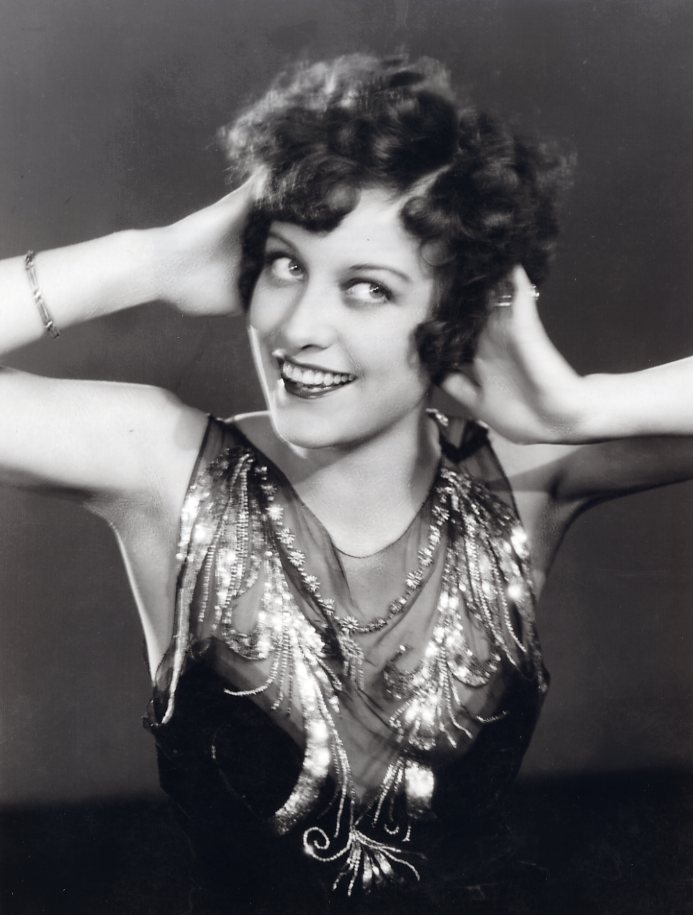
Joan realized early the importance of the star-making machinery, of which costume design was a foundation. Adrian’s talents extended beyond his fashion art, but embedded in his work was his understanding of the needs of the role, and significantly, the psychology of the actress and what it would take her to create that extra spark of creativity on the screen. In Joan’s flapper days, such as in Our Dancing Daughters (designed by David Cox) and in Our Modern Maidens, shown below, Joan embodied the notion of the flapper and was dressed perfectly as one. Later, when she played the sophisticated “kept woman” in Mannequin, Adrian dressed her in a completely different style for that role. And Joan absorbed these lessons in style and stardom eagerly. She wanted to pattern her stardom  after Gloria Swanson, the greatest star from years before. Gloria Swanson was a fashion icon, always well dressed – always the star – a role played on and off  the lot.
Flappers Joan 1

Adrian found Joan Crawford fascinating. Like the MGM star he loved most to dress, Greta Garbo, Joan presented him with the androgynous beauty that sparked his creativity. She had a beautiful figure with broad shoulders that Adrian admired, a “regular Johnny Weismuller” he reportedly said. She had normal hips, not wide as has often been reported, so there was no need to widen her shoulders in order to balance them out. Greta Garbo had wide shoulders too and Adrian used wide-shoulder costumes for both of them from 1929 on, just because he liked a wide-shouldered look on these two powerful women. Indeed, Adrian was always fascinated by polarities, and the contrast between the beautiful yet strong, almost dominant face of Joan Crawford below illustrates that characteristic.


Joan Crawford

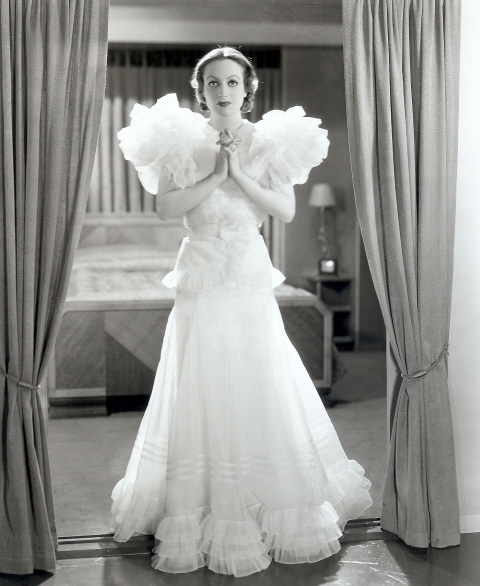
The costume designed for Joan Crawford that made Adrian famous was the “Letty Lynton” dress, named for the 1932 film of the same title. It has not been seen in decades due to a copyright dispute, but the puffed-sleeve (or shoulders) white organdy dress was worn by Joan on a ship’s deck when Robert Montgomery compares her to an angel and asks her to marry him. The dress was knocked-off by  American designers and sold at every price-point. Parisian designed copied it too, as did other costume dessigners. Edith Head stated it was the single most important fashion influence in film history. The Cinema Shop at Macy has often been cited as selling 50,000, or even 500,000 copies of the dress, although both figures are gross exaggerations done for marketing reasons. Versions of the dress can still be seen as wedding gowns.
 

Letty Lynton 2

The photo below is another gown from Letty Lynton, although it was shot on the set of Grand Hotel.  The gown is made of white crepe and black bugle beads, with one section forming a wrap tied at her hips. The other, forming a true assymetry on her left side. The image itself is a master-work of Hollywood set photography, with Joan forming a crucifix at the swinging art-deco doors of the Grand Hotel.


011

In Grand Hotel, 1932, Joan played a secretary. Adrian dressed her  simply in black dresses. Her predominant costume was the one shown below. Its large white collar emphasized her face, and its open structure showed her vulnerability to the advances of Preysing.

Greta Garbo also starred in Grand Hotel, although they did not share a scene. Garbo was notoriously reclusive and Joan had never talked with her on the MGM lot, and was rather intimidated by her. One day during the filming of Grand Hotel, Joan ran into Garbo on the stairs of the old MGM dressing rooms. Joan, locked in place and spellbound by Garbo, just said hello. Garbo put her hand to  Joan’s face and said, “What a pity, our first picture together and we don’t work together.  I am so sorry. You have a marvelous face.” Years later in retelling this story Joan said, “If there was ever a time in my life when I might have become a lesbian, that was it.”
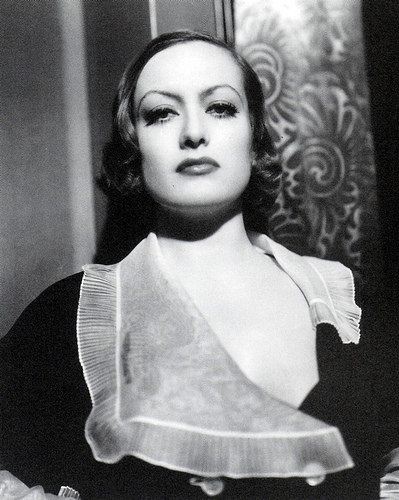
Joan Grand hotel

Adrian used the symbolic power of the modified trench-coat on Joan Crawford, just as he had with Greta Garbo since 1928. Below Joan is shown in Possessed, 1931. The Coat is only slightly feminized with the bow at the collar and at the belt, which is neutralized by a floppy cloche hat serving as a sort of fedora. She wears this outfit as she stands up to hecklers admitting that she’s the mistress of Clark Gable/ the character Mark Whitney, running for governor, but that he is an honorable man that once belonged to her but that now belongs to the people.

Joan Possessed

Joan Crawford, like many young actresses at MGM, had gone through voice class to lose her native twang and regional accent. While Joan had developed a beautiful speaking voice, there was no mistaking that she was a working class girl, and always seemed natural in the many rags to riches roles she played. It was also a factor in her popularity with the many young women moving into the cities and who were entering the workforce in the late 1920s and 30s.

TCM’s Summer Under the Stars is also playing Sadie McKee, a story where Joan starts out as a household maid, then becomes a dancer, and finally the wife of a rich man, though not the man she loves, played in the film by Gene Raymond.  This was another film where Joan co- starred with a future husband, in this case Franchot Tone. She had previously co-starred with Douglas Fairbanks Jr. in Our Modern Maidens (1929), whom she first married. And then of course there was Clark Gable, with whom she co-starred in eight films. They never married, although they carried on an affair that lasted many years. They always seemed well paired in their roles together, and their chemistry was always hot.

Joan & Gable 2
Joan Crawford and Clark Gable in Dancing Lady


Sadie Mckee features a rare Adrian-designed gown that bares Joan’s shoulders. The sequined halter adds a  lot of dazzle to the long black gown.

Sadie McKee (1934) Directed by Clarence Brown Shown: Joan Crawford
Sadie McKee. Photo courtesy Photofest

Probably the film where costume plays its most important role ever is The Bride Wore Red (1937)directed by Dorothy Arzner and starring Joan Crawford with Franchot Tone and Robert Young. Simply, an aristocrat character bets that he can take a tavern singer played by Joan and through a good wardrobe can pass her off as a high-society heiress at an exclusive mountain resort. His theory is that only luck separates the characteristics of the rich from the poor, so change the appearance and you change the person. and there ensnare the affections of the Robert Young character who disbelieves this theory. So he gives “Anni” enough money to buy an expensive wardrobe, and she chooses the most eye-popping brilliant-red bugle-beaded gown with matching cape in the store. So in this fractured-Cinderella-fairy-tale she goes off on the train to the Alps, where the postman played by Franchot Tone picks her up in a donkey-cart, her taxi to the resort. The costumes continue to play their significant part in this movie,  not to make the actress feel comfortable in her role, but in this Dorothy Arzner film, to always feel like she has chosen the wrong wardrobe for the occasion.

Joan Red Bride

It’s a bit of an irony that The Bride Wore Red was a black and white film, so who would have known what color the bride was wearing, even though she was not to be the princess bride. The photo below shows the gown as it looks today, miraculously preserved and in the collection of the Museum of the Fashion Institute of Technology, although here shown at the Hollywood Costume exhibition at the V&A Museum in London.

Hollywood costume V&A Bride Wore Red

The roles Joan played after World War II satisfied her less and less. Change was taking place at MGM. Garbo had left, and after that  Adrian. Even her long-time rival Norma Shearer has retired. New stars were getting the choice roles: Katharine Hepburn; Greer Garson; Hedy Lamar; and Lana Turner. After a  long review of her options, Joan had a meeting with Louis B. Mayer and asked to buy out the rest of the time on her contract. So on June 29, 1943, Joan left MGM, her home for eighteen years. Her last task was to clean up her dressing room, not just to pack up her personal belongings, but to physically clean it as well. No farewell party was held to see her off.

Her agent Lew Wasserman got her a contract at Warner Brothers., where a new phase of her career began.  She was once again given more serious roles in this new age of film noir. There was Mildred Pierce in 1945 for which she won a Best Actress Oscar. With new clout, she returned to Adrian for her wardrobe, selecting costumes from among his designs at his new  fashion salon in Beverly Hills. Thus did her next two films, Humoresque, and Possessed, get costumed by Adrian. Joan is magnificently  dressed in Humoresque, showing a mature beauty in an elegant and classic wardrobe.  Possessed calls for a simple wardrobe. In the film Adrian used a technique of reversing a white collar on a black dress, having the points of  the collar turned to the back of the dress. The look has been copied many times since.

Joan Crawford went on to a long career, embodying what it was like to be a star in Hollywood’s Golden Age, and beyond. Adrian’s star burned bright while it lasted, but his health failed him. A heart attack forced him to give up his own influential fashion line in 1952, and a planned comeback was stopped by a terminal stroke in 1959. Fortunately we have those many films to see for ourselves on TCM and elsewhere the art that was created in this collaboration and under the talented umbrella of many at in the Hollywood dream factories.


Views: 414

THE NOIR FILMS OF 1947

The year 1947 was a notable year for that developing genre of film, later to be dubbed Film Noir. Black Film – a style of bleak film-making fostered by the horrors of the recent end of World War II. Soldiers and sailors had just returned home after seeing all types of misery and death. Women had been on their own, working, if they hadn’t also  served overseas.  They were now tough and independent, and in Film Noir they gave as good as they got. They may have  been the femme fatale, but their fate was no better than that of their marks. A new realism was expected in the movies, reflecting the tough adjustment being made by tens of thousands of servicemen suffering from the yet to be diagnosed ailments of post traumatic stress disorder.

The film-making techniques of Film Noir themselves were also well-suited to the new realities of lower budgets at the movie studios. The foreign markets had disappeared altogether during the war, and were still soft in the post WWII war-torn economy. These techniques are classic in Noir: black & white film, B-film actors and directors, light and shadow to emphasize drama, humble interior sets and street location filming, flashbacks and voice-overs to tell part of the story, and single camera filming. Dialogue was key and always used a snappy back and forth style borrowed from pulp fiction, Raymond Chandler, and street slang.  Let’s take a look at some of the best of a large crop of films noir produced in 1947.

Film noir 4
Brute Force with Burt Lancaster and Ann Blyth


BRUTE FORCE: Directed by Jules Dassin  starring Burt Lancaster, Hume Cronyn, Yvonne de Carlo and Ann Blyth. Using a flashback technique, several prison inmates including Burt Lancaster as Joe Collins live out their days in a cell. Their sole diversion is a picture of a beautiful young woman, upon which they play out their nostalgic recollections of past sweethearts. Their flashbacks also revisit the circumstances that led each to prison, often involving betrayals. The ambitious prison captain played by Hume Cronyn is cruel and sadomasochistic, tempered only slightly by the prison doctor and warden. “Brute force” is what the doctor, played by Art Smith, calls prison Captain Munsey.The cell-mates’ miserable lives are made worse by the threat of stool pigeons in their midst. Hard labor assignments are given them in the prison drain pipes where they plan a prison breakout. Only a stoolie passes on the info, and a shootout results, and then a bigger prison breakout attempt.The doctor’s parting words say it all, “Nobody escapes. Nobody ever really escapes.” In this case that goes for the prison captain too.

The flashback trope of film noir works effectively here and serves as the light in contrast to the dark shadows of betrayal, fate. and prison life. The very early films of Burt Lancaster showed him as a perfect film noir actor. There was no ham or bravado, just the stoicism needed for the role. Director Jules Dassin was blacklisted in Hollywood so Daryl Zanuck at Fox sent him to London to make that masterpiece of Noir, Night and the City ((1950). He then moved to France where he made another Noir masterpiece, Rififi (1954).

Film noir Kiss_Death_1947_11
Kiss of Death with Victor Mature and Coleen Gray

KISS OF DEATH: Directed by Henry Hathaway, starring Victor Mature, Coleen Gray, Richard Widmark, Brian Donlevy and Karl Malden. This Fox film was based on a story by Eleazar Lipsky, with screenplay by Ben Hecht and Charles Lederer. It was filmed on location in New York in several places including The Tombs, the Bronx County jail, the downtown Criminal Courts Building, the Louisa M. Alcott house on Sullivan Street, the Chrysler Building and the Hotel Marguery. Other locations included Sing Sing Prison and Astoria, NY, and Fort Lee, NJ, all sites original to the story. The story itself centers on the character played by Victor Mature, a jewel thief and his gang who get nabbed. He is pressed to turn evidence on the others but refuses, under the mistaken assumption that his lawyer will take care of his wife and young daughters. With a long prison term and a tragic fate for his family, he later agrees to work with the D.A. and is released on parole.  His former baby-sitter played by Coleen Gray tells him what has happened and they begin a relationship. Her character uses voice-over to tell parts of the story. His goal is to get a sadistic drug user named Udo, played by Richard Widmark.

One scene in the movie made Richard Widmark famous, where he confronts Ma Rizzo, a gangster’s mother who is in a wheel chair, and pushes her down the stairs. The rest of the film was who was going to kill or capture whom. The Joseph Breen controlled Production Code Administration had problems with a lot of the script: drug-use and the Law’s reliance on stoolies to get their job done. The wheelchair-down-the-stairs scene was not well liked either. Richard Widmark in his first film had made his name. He was also nominated for a Best Supporting Actor.

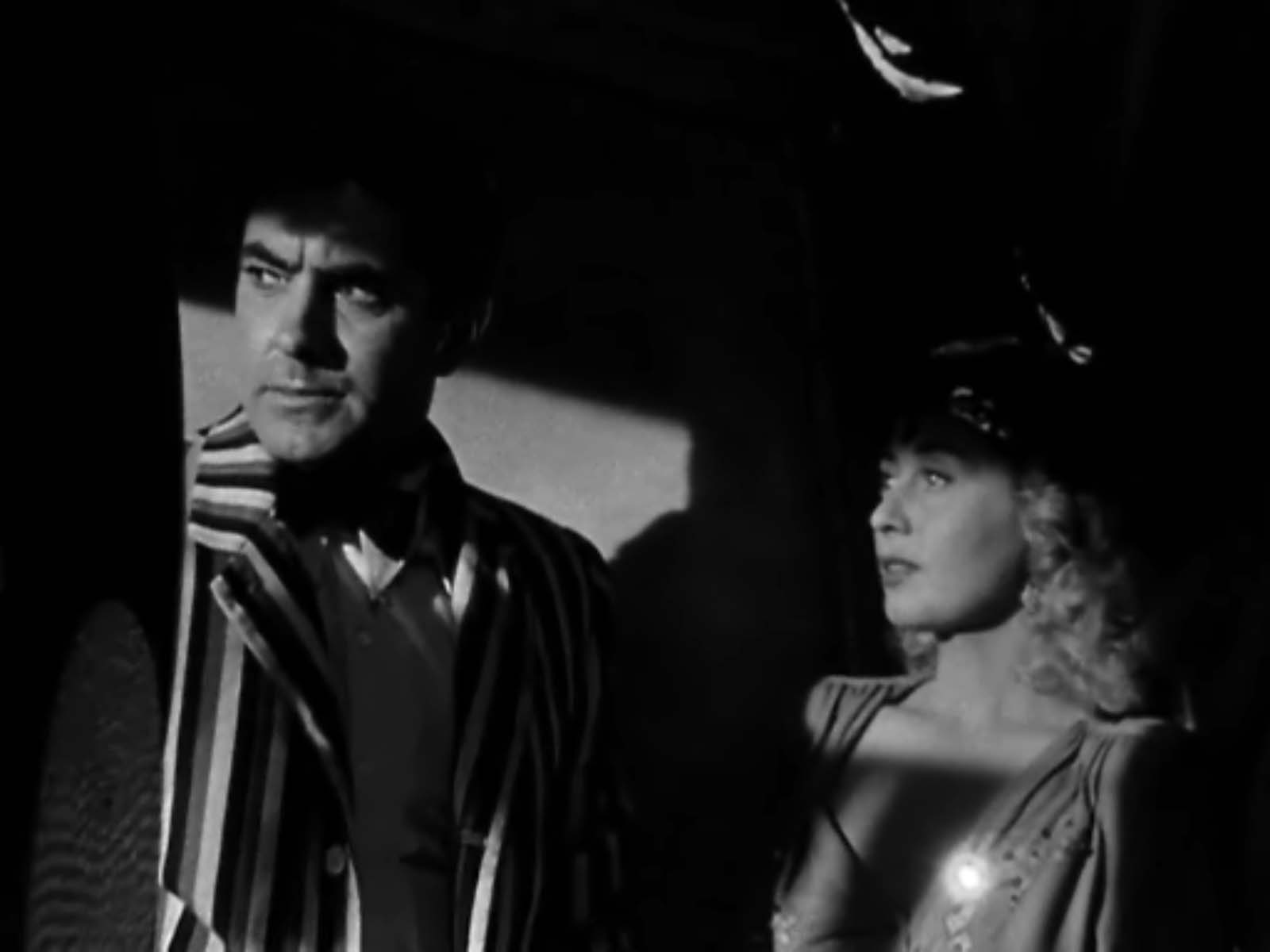
Noir nightmare-alley
Nightmare Alley with Tyrone Power and Joan Blondell

NIGHTMARE ALLEY: Directed by Edmund Goulding, starring Tyrone Power, Coleen Gray, Joan Blondell, Helen Walker, and Mike Mazurki. This Fox film was an unusual Noir, mainly due to its carnival setting and its fake spiritualist con game. It was also an unusual role for Tyrone Power, one he wanted desperately to play in order do get away from the handsome cavalier roles he was always portraying. Daryl Zanuck did not like the idea, however, of him playing the role of Stan Carlisle in the movie,. Carlisle was a smart and ambitious carnival worker, looking for an angle. So he angled himself into the carnival tricks of Zeena (Joan Blundell)  and Pete the alcoholic. Only he draws a bad Tarot card and Carlisle’s manipulative spiritualist con spirals up and then down, as he becomes an alcoholic and eventually a carnival geek, the lowest of the low among the travelling folk. All of this after he himself was manipulated out of all the money he cleverly swindled from other people in his spiritualist con game. His degradation is superbly acted by Tyrone Power, who was so cocky at the beginning of the film.

The script was based on William Lindsay Gresham’s pessimistic novel. The Production Code was not a fan of the resulting script, and the sexual relationships had to be eliminated. An even worse end for Power’s character was changed by Zanuck. Nonetheless, Tyrone Power’s fans did not like this role for their idol, and the film flopped. Today it is considered a cult classic and a Noir favorite.

Noir possessed 1947
Possessed with Joan Crawford


POSSESSED: Directed by Curtis Bernhardt, starring Joan Crawford, Van Heflin, Raymond Massey, and Geraldine Brooks, Warner Brothers. This disorienting Noir classic begins with Joan Crawford as the deeply disturbed Louise Howell as she is found wandering the nighttime streets of L.A. and is taken to a psychiatric hospital (back in the day when people cared and there were facilities to treat such people). Joan/Louise tells the doctor her story, a complex tale of reality and psychological fantasy caused by the death of her nursing charge, the wife of David Graham. Mrs. Graham’s daughter’s voice spooks her into thinking she is still alive, with jealous undertones implying a possible affair. The man Louise really loves, David Sutton, played by Van Heflin, always seems to be detached. Louise decides to quit but Dean asks her to marry him. They wed, but her past always interferes with her happiness. She imagines the ghost of David’s wife and believes that she was the one that killed her. She and Dean run into David, who is dating Dean’s daughter. They become engaged. David was the one she always loved and she becomes more and more unbalanced. She tells Carol that David really loved her. Dean tells her she needs to see a psychiatrist. She goes to David who tells her he will tell Dean all about their former affair. That’s when the pistol blazes.

Possessed is one of the few Noirs told from the woman’s point of view. It also won Joan Crawford an Academy Award nomination for Best Actress.

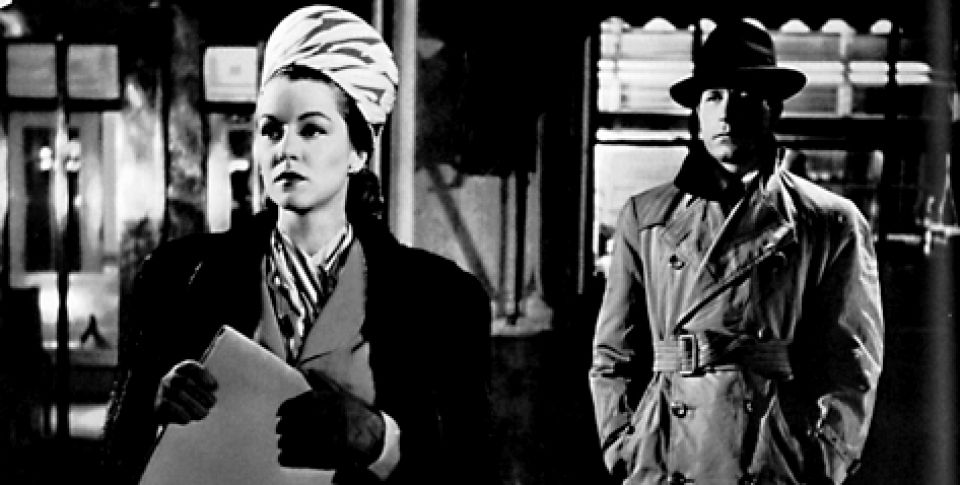
Noir Born to Kill

BORN TO KILL: Directed by Robert Wise starring Lawrence Tierney, Clare Trevor, Audrey Long, Walter Slezak, Elisha Cook Jr. and Esther Howard. Produced at RKO. Eddie Muller called this film noir, “The most perverse film of 1947.”  Joseph Breen of the PCA described this film as “the kind of story which ought not to be made because it is a story of gross lust and shocking brutality and ruthlessness.” The film was based on the book, Deadlier Than the Male, by James Gunn. RKO had to tone down some of the violence to get PCA approval. Still, the movie opens up with two cold-blooded murders committed by Sam Wilde (Lawrence Tierney), and when Helen Brent (Clare Trevor) returns to the boarding house of Mrs Kraft,  and sees the bodies, she cooly flees, taking a train to San Francisco from Reno where she was there to get a divorce. Taking the same trip is Sam, who strikes up a flirtation. They had met briefly in Reno’s casino before she returned to see the murder victims. She is uninterested, but is equal parts attracted and repelled by him. In San Francisco, he comes to visit her at her rich half-sister’s house, where Helen’s fiance is present. To Helen’s distress, Sam courts Georgia, her rich half-sister, whom she is jealous of. Soon the two marry, but Sam  shows he’s really interested in Helen, seeing in her a kindred spirit. Meanwhile Mrs. Kraft hires a private detective to investigate the murders, and he finds his way into the mansion during the wedding, and finds evidence that Sam committed the murders. He relays this to Mrs Kraft, who Helen then visits and threatens her by saying Sam would kill her if she conveyed that information to the police. Mrs Kraft sees the cool manipulation behind the threat, and says, “You’re the coldest iceberg of a woman I ever saw. I wouldn’t trade places with you if they sliced me into little pieces.” And soon enough Sam’s friend does try to slice her up. And most everyone gets it one way or the other in this movie.  Eddie Muller’s description pretty much summed it up.  It’s a pretty black film noir.

Noir High Wall 1947 blogathon
High Wall with Robert Taylor and Audrey Totter


HIGH WALL: Directed by Curtis Bernhardt, starring Robert Taylor, Audrey Totter, Herbert Marshall, Dorothy Patrick, and H.B. Warner. MGM. This little known Noir is another directed by the German Curtis Bernhardt, who directed Possessed, above. This has a somewhat similar plot as The Blue Dahlia, where  U.S serviceman, Steven Kenet played by Robert Taylor, also a pilot, returns to a wife who is having an affair with her boss. Soon after his return he is arrested after an accident where he tries to kill himself – with her dead body in the trunk of his car. Only now he remembers nothing. He is placed in a psychiatric hospital where a blood clot is found in his brain. Surgery is called for to remove it but he refuses the surgery. The Assistant  D..A. suspects that Kenet is angling for an innocent plea based on a mental defect. Dr. Ann Larison played by Audrey Totter  convinces him that he should have the surgery in order to keep his son from going to an orphanage.  The surgery cures him but his memory of the event does not come back. Only after she gives him sodium pentothal does he recall what happened, and who the real guilty party was. By then he and Ann were falling for each other. And when someone stepped forward with some evidence but was then murdered, they hatched a plan. Only he is still confined to the psychiatric hospital, or can he get out to prove himself?

This is a stylish Noir with deep black and white cinematography and fine acting. It deserves better recognition.

Noir 1947 blogathon
T-Men

T MEN: Directed by Anthony Mann, starring Dennis O’Keefe, June Lockhart, Mary Meade, Wally Ford and Alfred Ryder. The movie was shot in a documentary style about the Treasury Men and the crooks they were after. Location shooting took place in several places in Los Angeles and Detroit, Washington, New York, and San Pedro, including the L.A. locales of the Farmer’s Market, and the former Pacific Ocean Park. The story is about a couple of Treasury officers infiltrating a counterfeiting gang in L.A. Their cover is that of bank robbers – but their mission is dangerous, and one of them will not come out alive. The cinema verite style is perfect for the story that was ripped right out of the files of the Treasury Department.


OUT OF THE PAST: Directed by Jacques Tourneur, starring Robert Mitchum, Jane Greer, Kirk Douglas, Rhonda Fleming and Virginia Huston. RKO. This classic Noir is also my favorite, an outstanding mixture of talent, story, cinematography, and film noir filmmaking. The story opens with Robert Mitchum as Jeff Bailey enjoying a peaceful life in California’s Sierra Mountains, working at a gas station when two former shady acquaintances from out of his past drive up. In a film noir movie that’s never a good sign. They want him to see a former client from his P.I. days, and he agrees to go. This prompts him to tell his girlfriend Ann about his past before he goes. Kirk Douglas as Whit Sterling has a new P.I. job for him for good money: find the girlfriend that shot Whit and then ran off with $40,000 of his money. Jeff finds her after several days of loitering in the cantinas of Acapulco. And after several rounds of sharp cat-and-mouse dialogue and some flirting, Jeff falls in love and into the clutches of the doe-eyed beauty and femme fatale Jane Greer/Kathie Moffat. This was made easier by her protests of innocence. But Whit trusts no one and shows up in Acapulco.. Luckily they were not spied together, and Jeff and Kathie manage their escape. They live together for a while, but fate always lingers in film noir, and a blackmailer spots them and trails them to a cabin in the woods.. As the men fight it out in the chiaroscuro lighting, Kathie looks on with delight, waiting for the right moment to shoot and kill the blackmailer, then take off with the $40,000 she had all along. From there she ends up back in the arms of Whit Sterling, and now Jeff Bailey is the sucker, having to pay off debts to Whit by doing lousy jobs that lead into a downward spiral of bad fortune for all.

Film noir Out_of_Past_1947_7
Out of the Past with Jane Greer and Robert Mitchum


The year of 1947 had many more Noir films of merit. The entire year had many excellent films , blogged about in the 1947 Blogathon, hosted by ShadowsandSatin and Speakeasy

Views: 864

WHEN FASHION SOLD THE MOVIES: 1930-1940


In the beginning of Hollywood’s Golden Age in the 1930s, movie marketing was already an old trade, but one of its newest tools was selling the movies based on the fashions that would be worn by the stars that appeared in them. Unlike recent times, it was the women that decided what movies a couple would see, and women stars dominated the screen. In the late 1920s,  exotic costumes or bold flapper looks were already drawing attention. But with the arrival of the 1930s, the studios planned methodical campaigns to attract women to the new releases by placing fashion images of the stars from the upcoming movies in magazines and newspapers. For this marketing to work, the stars’ costumes would have to be the best and most appealing fashions, and so the studios hired the best designers they could find.

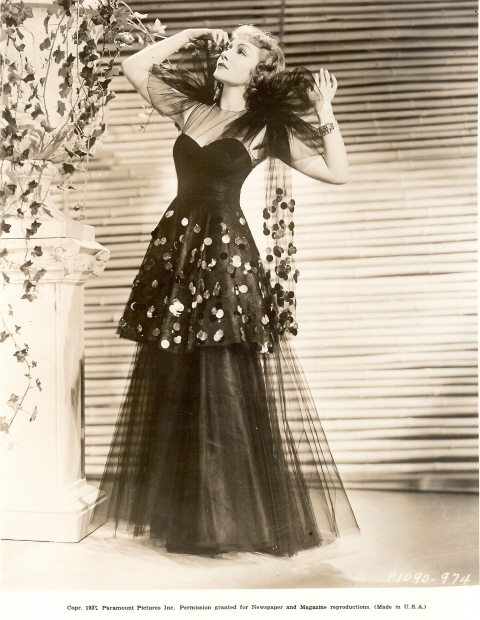
Fashion in Movies ClaudetteColbert_Bluebeard'sEighthWife
Claudette Colbert in “Bluebeard’s Eighth Wife,” designed by Travis Banton, 1938. The publicity emphasized the “minaret silhouette” and the tulle fabric dotted with gold and black sequins, with the large tulle bow.

And the studios publicized their designers almost as much as their movie stars, and they became household names during the heyday of the 1930s. Newspapers regularly covered film fashion as part of the publicity for a film: what the stars wore; and which costume designer was responsible, all as part of a film’s publicity. Fan magazines like Photoplay, Screenland, Movie Mirror, and others regularly carried articles and photographs about what film fashions and costumes the stars would be wearing and what tips on dressing the costume designers had for the average woman. In the 1930s through the 1950s, print media was the dominant form of advertizing and promotion, and the combination of print and still photography was used to sell movies by promoting the look of the movie stars. This meant an emphasis on fashion and costumes, and since the female audience had been found to make most of the decisions on which movie showings to attend, this well into the 1940s, women were specifically targeted by emphasizing the importance of costuming in film. This was at the very peak of film attendance in U.S. history. This period was also one where women entered the workforce in large quantities. There was a shift from rural to  urban living, and one where young women were influenced by the dress of the young female stars on the screen, often playing roles that echoed their own lives. Realistic or not, the message often was, “with the right clothes you get the right breaks.”

Fashion in Movies Wendy Barrie_A Feather in Her Hat
The smiling face of Wendy Barrie is shown wearing white faile blouse with a tiered collar and pronounced peplum as publicity for Columbia’s “Feather in Her Cap, 1935.
Fashion in Movies Fay Wray_ The Richest Girl In The World_1934
Fay Wray models a “lip-stick red” velvet evening gown designed by Walter Plunkett at RKO for the film, “The Richest Girl in the World.” It has an interesting cowl neckline.

The contemporary movies, those depicting the times when the movie was released, were those where the studios could produce the most publicity about the fashions worn by the stars on-screen. Accordingly, male and female actors wore the fashions of the day, at least of the day when the movie was made. Since fashion trends change so quickly, classic Hollywood always had a potential problem with its contemporary movies. Even in the heyday of the studio factory system, it took a number of months between the time costumes were designed and when the film was released. During those months a new style could be launched, or a current style could become passé. This happened in 1929 when the popular irregular-length, handkerchief-hemmed dress was suddenly demode when Jean Patou introduced the long skirt. Movies featuring the former looked out of fashion, and some had to be re-edited with actresses filmed from the waist up. This happened relatively early in Hollywood’s history, but from then on the studio moguls decided they would employ the best costume designers they could find, and would emphasize a classic Hollywood style of fashion, and one that took full advantage of the sex appeal of their roster of stars and starlets.

Fashion show Joan-Mannequin 3
Adrian turned Joan Crawford from a former flapper into a sophisticated dresser in “Mannequin,” in 1938.

Thus in the 1930s, MGM had Adrian, who created the looks for Greta Garbo, Joan Crawford,  Jean Harlow, Jeanette MacDonald, and many others.  At Paramount there was Howard Greer followed by Travis Banton and then Edith Head. Warner Brothers had Orry-Kelly and Milo Anderson.  RKO had Walter Plunkett, Bernard Newman and Edward Stevenson. Fox, later the merged 20th Century-Fox had several designers come and go until Charles LeMaire became the Head Designer. Irene, working out of Bullock’s Wilshire, designed the wardrobe for major stars at several studios.

Fashion in MOvies  RKO_1936
Lily Pons in a silver lame wedding gown. Miss Pons, an opera diva, and this gown from “That Girl from Paris”was photographed by George Hurrell in full color for Photoplay

Samuel Goldwyn wanted to capitalize on fashion for his movies, going to France and the Haute Couture for a designer, where he found Chanel. He thought he could get both publicity and the avoidance of the problems of changing hemlines and styles by going direct to Paris. He hired her in 1931 to design the costumes for his film The Greeks Had a Word for It. Chanel also designed the costumes for Gloria Swanson in Tonight or Never in 1931. But Chanel and Swanson never got along , or were able able to establish a working relationship. Chanel was in Hollywood to take her measurements but then went back to Paris. By the time the costumes were made Gloria was pregnant and they no longer fit. And while the costumes were chic, they seemed to fall flat on the screen. In any event the film never did well and Chanel never came back to work as a costume designer.

Fashion in Movies Gloria Swanson
Gloria Swanson in “Tonight or Never” designed by Coco Chanel

It was in the 1930s that the iconic look of Hollywood glamour was developed by costume designers Adrian, Travis Banton, Irene, and others. This was done out of a need for that timeless style, but using a combination of new couture techniques of bias-cut dressmaking with luxurious fabrics like silk satin for form-fitting gowns worn by stars like Jean Harlow ,Joan Crawford, Claudette Colbert, and Carole Lombard. And the costume designers not only designed the look of glamour, but the simple-but-elegant styles that women aspired to, as well as the casual outdoor styles and bathing suits popular in California. During Hollywood’s Golden Age, American woman looked to movies for their fashion cues, and women across the world did too.

Fashion in Movies Loretta Young_Second Honeymoon
Loretta Young in “Second Honeymoon,” designed by Gwen Wakeling

The imagery and glamour of Golden Age Hollywood was developed in synchronicity with the tools to sell the movies through fashion. The Studio Portrait Gallery and its skilled photographers were put to use in taking glamour photos of the stars in their stunning gowns and beautiful dresses, all costumes they would be wearing in their upcoming movies. These ravishing images would be placed in fan magazine glossies and would still look good in newspapers. The most expensive of the movie  magazines, Photoplay, cost 25 cents in the 1930s. Vogue cost 35 cents while Harpers Bazaar cost 50 cents. The cost of a movie ticket was 25 cents in 1936.

Fashion in Movies Kitty Carlile_Here Is My Heart_1934
Kitty Carlisle in “Here is My Heart,” 1934, designed by Travis Banton

In the January 1932 issue, Photoplay had the article, “Let Screen Clothes be Your Guide to Wearable Fashions,” with a photo-spread of stars in current movies including Joan Crawford in Possessed. and Norma Shearer in Private Lives, both designed by Adrian.  Photoplay  magazine also had the leading studio costume designers give the “Fashion Forecast” for the seasons. Kalloch wrote  his forecast article for early Fall, 1935, outlining fabrics, furs, skirt lengths and other design elements, all accompanied with photos of the stars he designed for in their coming films. Travis Banton did the same for Photoplay for Autumn 1935, the article including some of his costume sketches. Banton stated there would be return to the era of elegance, with rich fabrics, furs, gold and silver brocades.   And with the current emphasis on the draped silhouette, chiffon would still be useful even in winter. The studios had been successful beyond their dreams in selling movies through fashion. The very image of the stars had usually been created by the studio’s costume designer, often paired with the star over many years. Sometimes the studios would also license a designer’s name to a fashion line, or otherwise publicize their creations as part of the film. This marketing arrangement worked very well through the 1930s up until the beginning of World War II. A variety of things happened to place this system in limbo. With the late 1950s it made a brief comeback but then disappeared with the demise of the studio system.  Only its relics and memorabilia remain today, although the films made during the period show – not the marketing – but that the emperor really did have clothes, and beautiful ones at that.   SONY DSC The photo above shows Joan Crawford wearing the famous “Letty Lynton” dress from the movie of the same title, 1932, designed by Adrian. It was knocked off by designers everywhere including by Parisian couturiers. The Macy’s Cinema Shop reportedly (but with much exaggeration) sold 50,000 copies of it.

This blog post is part of the   Classic Movie History Project Blogathon, hosted by Movies Silently, Once Upon a Screen, and Silver Screenings


Views: 2603

FAN FAVORITE MOVIE COSTUMES


When I asked some classic movie fans for what  their favorite movie costumes were I got some surprise answers. These were heartening in this age of narrowing focus on “the best”or more often “the most mentioned in the media” answer to such a question. But then again I was dealing with a group of discriminating and knowledgeable film fans and fellow bloggers. Their answers also run the spectrum of older classic and more recent movie costumes and film fashion, some are well known and some not at all.  Here are their responses:

Patricia Gallagher’s favorite gown was worn by Grace Kelly in Rear Window,  this was the dramatic black and white coctail dress she is first seen in at Jimmy Stewart’s apartment. Edith Head designed it with a simple black decollete top and a full white chiffon skirt decorated with beaded twig decorations in black. It was quite smashing, one of Edith Head’s best designs. Grace wears black strappy heels with the outfit.

Grace Rear Window2

Deborah Thomas said her favorite was worn by Deanna Durbin in It Started with Eve, 1941. This outfit was designed by Vera West in a scene where Deanna Durbin is chased around a piano by her beau Robert Cummings. Deanna Durbin was a huge star in the late 1930s and early 1940s. She single-handedly kept Universal solvent with her popular films. Vera West designed costumes at Universal from 1928 until 1947.

Favorite Movie Costumes Durbin, Deanna (It Started With Eve)_01

Marsha Collock said her favorite was the “love bird dress” from  Gone with the Wind, 1939, designed by Walter Plunkett. The gown was made of blue silk and has “love-birds” sewn diagonally onto the front and right shoulder of the gown. It is seen briefly during a honeymoon scene in New Orleans. The gown is rarely seen in photographs. It was reportedly owned by the Montgomery Museum of Fine Arts as late as the 1970s, but was in poor condition then.

Favorite costumes GWTW

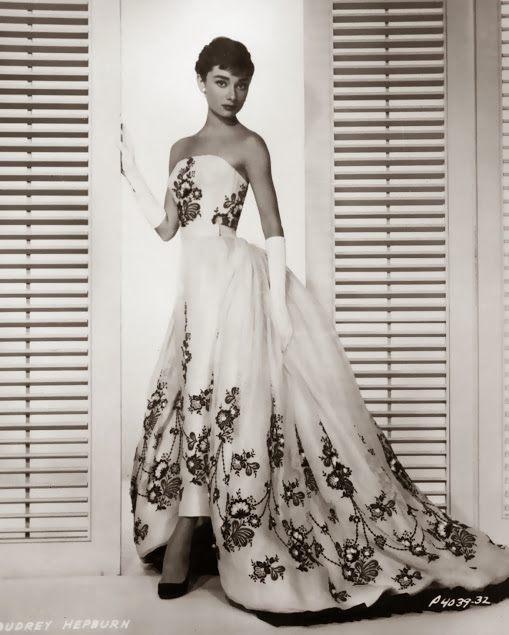
Jacqueline T. Lynch said her favorite costume was Audrey Hepburn’s garden party gown from Sabrina  designed by Hubert de Givenchy. It is embroidered with black floral decorations on white silk organza. The gown has a detachable train that flows from the hips.

Audrey Sabrina

Dan DeSantis said he had many favorites, but especially the men’s fashions worn in The Red Shoes. Indeed, these are striking to me as well. The chic but casual style of the clothing of the International set at the Riviera, 1925-1965, is a lost art. This was a time when men believed in dressing up to look their best in their leisure, though here they are so dressed in producing art. The stills don’t do it justice, so the film has to be seen to appreciate the men’s wardrobe (and this wondrous  film as a whole).

Favorite costumes red shoes

Danny Reid’s favorite was the classic 1930s look of Kay Francis in Mandalay, designed by Orry-Kelly, 1934. The puffed tulle shoulders became popular after the “Letty Lynton” dress that Adrian designed in 1932. Kay Francis was a style-setting clothes-horse of the 1930s.

Favorite costumes Kay Francis

Aurora Bugallo’s favorite was worn by Eve Marie Saint in North by Northwest, 1959It’s a black silk dress with red embroidered roses, with a deep v-cut back. The dress was selected by Eve Marie at Bergdorf-Goodman in New York, where Alfred Hitchcock was filming. The costumes were designed at MGM but the head- designer Helen Rose was unavailable at the time and Hithcock didn’t like what had been provided. This one provided plenty of drama.

Favorite costumes North by Northwest

James Kelly said his favorite costume was worn by Elizabeth Taylor in Raintree County, 1957it was a cream colored tulle and lace ball gown designed by Walter Plunkett. This movie was one of Walter Plunkett’s best costume productions.

Costume favorites Raintree County Bob Willoughby

Billy Alvarez said his favorite costume is Deborah Kerr’s ball gown from The King and I, 1956designed by Irene Sharaff. The copper-colored satin gown with train and puffed lace sleeves was worn by Deborah Kerr as she danced with Yul Brynner. Irene Sharaff won a Best Costume Oscar for the film.

Favorite costumes king & I

Darian Dare’s favorite costume was Barbara Streisand’s “On a Clear Day You Can See Forever” white satin decollete gown worn with a collar and headpiece in Funny Girl, 1968, designed by Irene Sharaff.

Favorite costume Barbara Streisand

Patricia Nolan Clark said her favorite costume was worn by Jane Wyman in Just for You, 1952. Jane’s costumes were designed by Edith Head.

Favorite Movie Costumes  Jane Wyman

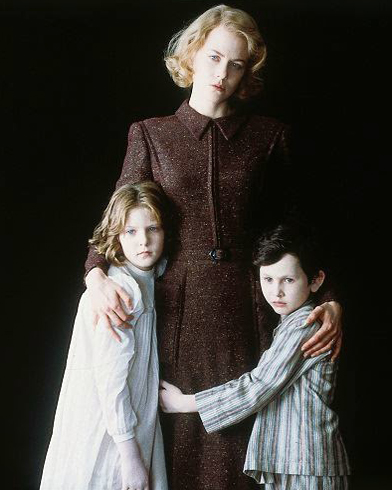
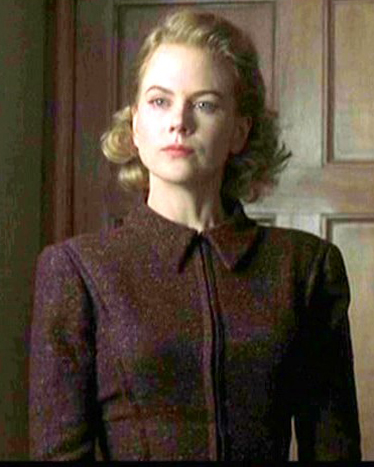
Becky Barnes said her favorite costume was worn by Nicole Kidman in The Others, 2001. This mauve-colored outfit was designed by Sonia Grande. Its simplicity and somber tones fit the character and the plot. and This costume designer is not well known, although she has designed Midnight in Paris and Vicky Cristina Barcelona for Woody Allen.

Favorite costumes Nicole Kidman The Others

Favorite costumes Nicole 2

Michael Munnelly’s favorite costume was worn by Kate Winslet in Titanic, 1997, designed by Deborah L, Scott. This was Rose’s peach-colored and sequined black lace gown worn early in the film when she wants to jump overboard before Leonardo Di Caprio prevents her from jumping. This costume sold at auction in 2012 for $330,00.

Favorite costumes Titanic

Barbara Allen’s favorites were the sarongs that Dorothy Lamour wore in several movies starting with The Jungle Princess, 1936, The Hurricane, 1938, and several subsequent movies. With the start of World War II, silks and other fabrics became restricted or hard to find. Silk was used for parachutes, and European fabrics had been cut-off by the war. Barbara Allen’s mother was a specialist working at the Paramount Pictures’ Wardrobe Department, where she hand-painted the floral prints on sarongs and other costume’s fabric due to its otherwise unavailability in sufficient variety.

Dorothy  lamour  in  a  knockout  pictorial  spread!!!

Inge Gregusch said her favorite costume was worn by Greta Garbo in Inspiration, 1931.  This is a stunning Adrian-designed black velvet gown and train with cut-crystals at the neckline and shoulders, with long gauntlet gloves. The gown has survived, and was recently exhibited at the Boston Museum of Fine Arts Hollywood Glamour Exhibition.

Favorite costumes Inspiration gretagarbo

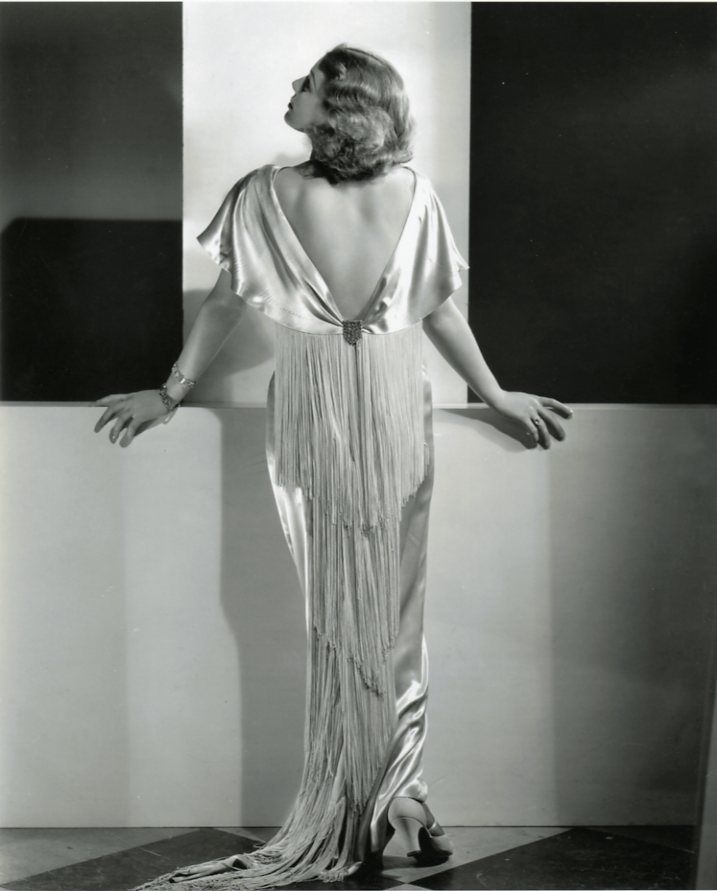
And what’s my own favorite? There are so many. But to be fair to the those that responded, I too will pick just one. So here it is. Loretta Young in Midnight Mary, 1933, designed by Adrian. This silk satin gown with the caped shoulders, exposed back, fringe train, and accessorized with a medallion is too beautiful. And its the cover of my book on Adrian.

Favorite costume Loretta in Adrian


Thanks for sending in your favorites They are all wonderful!


COMMENT BUTTON AT TOP

Views: 363

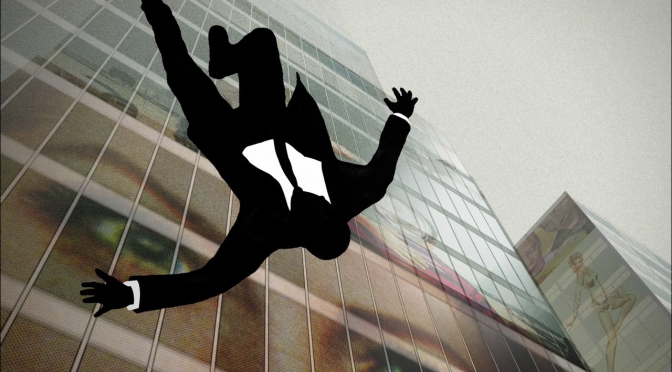
MAD MEN: A LOOK BACK


Now that Mad Men has concluded and is television history, what did it all mean? What was it about this series that went deep to the bone, and the brain? Several TV series have storylines that got us hooked, but Mad Men entered our psyche. The reason may be a simple one – it was a story whose characters we could relate to, or even see ourselves in.

Matt Weiner may have indeed begun the story of Mad Men as a sort of Great American novel, a story of how a man of humble origins makes it in the material world, a Jay Gatsby of the mid-century, yet despite all his success he is unsatisfied with his life. And like Jay Gatsby, he has to pass as someone who “belongs” among the class of people he frequents and does business with. Mad Men is the journey of this outsider into the heart of American capitalism, where women too, outsiders or not, find obstacles and worse at every turn. Along the way the gloss, spectacle, and magnetism of American life as portrayed in advertising attracts all. Here are the keys to understanding the show, as one writer sees them (there are spoilers):


1) DON DRAPER  – Don Draper was born Dick Whitman and took Don Draper’s name and identity, so he’s always aware that he is posing as someone that he is not. On top of that he was born in deep poverty, born to a prostitute mother who died giving him birth, and  to a father that died when Don was young, then he was raised in a whorehouse. He was neither loved nor wanted and this lack in his developmental stage was always a hole that could never be filled as he moved from one woman in his life to another, never believing he’s really loved. His outsider status has made him an obserer of human nature. In business his intelligence, creativity, understanding of others, and his forceful personality have made him a winner at sales and on Madison Avenue, but he’s in a world of rich men, old WASP families, and corporate connections that he’s a stranger to. He’s always on a tightrope, where a false move of letting his rural-poor background or false identity show could take down his house of cards. Pete Campbell comes from an old money New York family – he always had it easy, and thus tends to be “entitled,” in his attitude. His confrontations with Don are perfect symbols of talent vs. title. Yet with all that Don’s skills and talents bring him, the hole remains. As he jettisons one relationship after another, the hole only swallows more of him. As he writes in his own diary, “We’re flawed because we want so much more. We’re ruined because we get these things, and wish for what we had.” Naturally, his marriages are rocky, and he has never learned to trust love, and he doesn’t know which is the real person to present himself as. For all of his strength as personifying the modern ad man, he is haunted by his past. Flashbacks occur throughout the series, as a device to explain his character, but to leave mysterious gaps. Who was that woman in “The Crash” episode, a typist/assistant to Ted Chough, that Don saw after his “pick me up” shot, then walking down the stairs. “Do I know you?” “I mean have we met before now?” he says to her. She looks much like Diane of the Diner from a much later episode, but here she serves to bring a flashback to an earlier ad for soup with a similar looking woman in illustration, “You know what he wants,” the ad says, as a mother overlooks a boy. This ad and the image no doubt designed to come from Don’s head. It sends him on a mad rush to find the old ad.  And since a flashback occurs of his first sexual experience in the whorehouse where he grew up, following the only female tenderness he’d ever had, Don conflates imaginary motherly love , tenderness, and sex, followed by some traumatic event.

mad men don draper


2) PEGGY OLSON – Matt Weiner has said that of all the characters, Peggy is his favorite. Don is her mentor, but she has the earnest and steady perseverance to learn from each mistake, disappointment, and negative encounter, and to grow stronger. She shares with Don a family life where love was lacking, and her relationships with men have been rough. She is always undervalued and has to work harder to compensate – this the very story of women in the white collar workplace. Like Don she too must know and do all that is required of her, while “passing” as one of the boys. She must do all that Don has done but with the disadvantage of being a woman, and for part of the show, she still dresses like a girl, making it even harder to be taken seriously.  In the still-sexist 60s office-place, this is constantly degrading. Like Don, she is intelligent and understands people and their motivation and can put together the best ads. Her ad campaign for Burger Chef was brilliant. Her success takes longer to achieve, and she doesn’t have Don’s confidence, despite his background, but when she arrives she will never doubt herself again.

Mad Men Burger Chef

3) JOAN HOLLOWAY HARRIS – Joan is the opposite of Peggy in the Sterling Cooper & Partners enterprise. She is tough and has been around the block. But in contrast to Peggy, Joan is sassy and sexy -obviously so. She is thus the butt of every look and sexist joke and overture that today fills up sexual harassment training manuals. But her years of experience and level of skill only makes her fit to boss the other “girls” in the office.  In Series 3 The English assistant John Hooker calls the office a “Joanocracy.” But when she later makes partner at Sterling Cooper Draper Pryce, it is only because she  agreed to go to bed with the owner of the Jaguar dealers, this to win the account for the partners (which Don objected to). Joan does not get along with her mother, a characteristic shared by Pete Campbell and  Roger Sterling. She has had a close relationship with Roger Sterling, and has had his child. She never lacked confidence or doubt, and knew what she wanted to do when faced with decisions about maternity with another man’s child, had compromised sex in exchange for comfort for life, rejected a binding relationship, and finally started her own business. As an influence, Joan as played by Christina Hendricks brought back the sexy hourglass figure of the 1950s as a  popular image and style.

mad-men Joan-christina-hendricks


4) ADVERTISING – This was the period in American history where the circular symbol: Mass Advertising – Mass Consumption – Mass Production  was itself a bus ad. New products came to consciousness through glossy ads that were hypnotic in their appeal. The ads symbolized the good life – the American life that was the envy of the world. The center of the advertising business was on Madison Avenue in New York, hence the term Mad Men. The advertising agencies worked for the corporations that fed a steady stream of products into the American home. In the show, these corporations and their products are named: Kodak; Lucky Strike; Hershey Chocolate; Heinz; Dow Chemical; Chevrolet; and Coca-Cola, among others. Everyday household feminine products from Topaz hosiery to Playtex brassieres are subject to ad campaigns, and the cause for sniggering from some of the male ad men. The advertising agencies themselves form their own phalanx into the business world: McCann-Erickson;  Putnam, Powell & Lowe, Ogilvy & Mather, and Sterling , Cooper, Draper, Pryce. The David Ogilvy  of the above firm wrote, Confessions of an Advertising Man, a manual for the type.

5) 1960s – 1960 is where Matt Weiner wanted to begin his saga of  Don Draper and the Mad Men. It was a decade  that started with social stability but ended with social upheaval. The beginning of the decade looked much like the 1950s, a period still trying to forget World War II and trying to ignore the Korean “conflict” from which Don Draper sprang. The sanitized versions of home life and sex as seen on the censored TV-shows and movies, especially the popular Lucille Ball shows and Doris Day films of the period gave misleading views about sex, (or the lack thereof). The late 1960s didn’t invent screwing, or screwing around. The tug of war of the social forces is evident in the deep white male dominance of the work place, unabashedly enforced over  women, regardless of their title.  As these forces are more fought over as the decade progresses in the show, the women become more assertive, yet there are still miles to go for anything resembling equality of the sexes (still elusive today). If anything the 1960s was grabbed by youth for changing their own paths to freedom. And the 1960s provided a lot more color in the advertising graphics to come, led by the revival of poster art for concerts and hippie be-ins. Much later still, that most subversive 60s convulsion , rock-and-roll music, would be a constant sound track feeding television commercials. As the 1960s progress in the show, the major events are reflected in the plots and reactions of the characters: the assasinations; the civil rights movement; Viet-Nam; the moon-landing; the youth-movement. The dynamics of office politics and agency take-overs continues, along with drinking, smoking, and sex.

mad men Milton Glaser
Poster by Milton Glaser

6) FASHION & DECOR – The look of Mad Men made waves from its very beginning. The early 60s women’s fashions resembled the late 50s women’s fashions, with the New Look silhouette still in vogue. The silhouette was enhanced by girdles and cone-shaped bras, and nylons and garters were de rigeur. Although vintage garments are available and used as costumes, vintage undergarments are not so available, so the silhouette is not strictly correct, but nonetheless costume designer Janie Bryant made a a big hit with her retro fashions for the show. The total look included accessories, which were almost mandatory in the early 60s, with hats, gloves, shoes matching handbags. necklaces, and earings.

mad-men-fashion-promo
Left to right January Jones, as Betty Draper, Christina Hendricks as Joan Harris, and Elizabeth Moss as Peggy Olson


Mad Men fashion
At left is Maggie Siff as Rachel Mencken

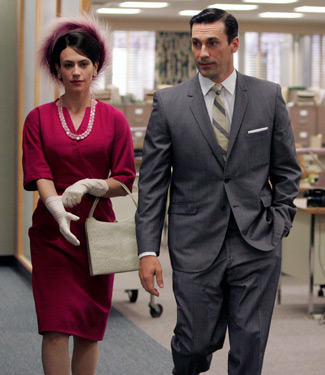
Rachel Mencken as a Department store owner knows how to dress with taste. She’s also beautiful and attracts Don’s attention immediately, beyond being a client. Don’s wardrobe is straightforward but he wears clothes well. He adds class by wearing French cuffs on crisp white shirts and his ties are always impecable. His pocket square adds a nice note. He and the other Mad Men in suits strictly follow the code of unbuttoning their jacket when they sit and buttoning it when they stand – always.


mad-men Betty & Don

A form-fitting floral print dress worn by January Jones looks smashing – its colors especially flattering to her.

Mad Men fashion group

The late 1960s bring the Mod years and contrasting looks to the office. Jessica Pare as Megan Draper, who plays an aspiring actress is alwayss the most fashion forward. Her mini-dresses and bright-colored paisley-print outfits are very hip and sexy. The men are dressed either in suits or sport jackets, and the “creatives” take on the look of college students and bohemians.


The set designs for Mad Men were as influential as the costume design. The sleek mid-century look in offices and homes, influenced by modern architecture and Danish-design inspired furniture, became a popular trend in decorating and interior design. The original offices of Sterling- Cooper are also noteworthy for the framed art, so typical of the late 1950s and very early 1960s – all very linear and abstract

mad-men-drapers-office-9

Don and Megan’s new condo is also very modern and attractice, with a sunken living room and large terrace.

mad-men-season-5-dons-new-house

7) MUSIC – Soundtracks are ever-present in TV shows and movies, where they set the mood and help pace the story or even foretell the action to come. An extra dynamic plays out in Mad Men’s music however, more exactly in its songs. Its in the lyrics and especially  the titles and refrains that reinforces the point of the story.  In Season 1 Episode 2 Peggy is the new girl, typing while  looking around at the men’s offices while the Andrew Sisters’ song I Can Dream Can’t I, plays. In Season 6 Megan and Don watch TV as the news covers the assassination of Bobby Kennedy, the song Reach Out of the Darkness , by Friend and Lover blares out. Season 7 started out with Don put on leave, but a classic shot opens of him arriving to the still small LA airport, dapper in hat and suit, shot in slow motion as Megan meets hint in a wind-blown mini-skirt, with I’m a Man by the Spencer Davis Group pumps the California sunshine through the scene. This music is contrasted with a later scene of Don breaking down, alone in his condo to You Keep Me Hanging On by Vanilla Fudge. Or can one ever forget the number and the sentiment of Bert Cooper’s farewell, ghostly, song and soft shoe message to Don with The Best Things In Life Are Free, in Season 7 Episode 7?

mad-men bert cooper

The songs of sadness and looking back are present as well. When Don sells his condo, the soulful and heart-wrenching, The First Time Ever I Saw Your Face by Roberta Flack plays as he stands alone. Other songs showing direction are used are used. When Peggy and Don are in the office late at night in Season 7 Episode 6, with Peggy doubting her steps in an ad campaign, Don points out the song that keeps playing on the radio, an omen he thinks, its Frank Sinatra’s I Did It My Way, and he invites her to dance. Later in the series Don fixates on a restaurant waitress named Diana. When he goes to see her there alone, the song Louie, Louie by the Kingsmen plays. The almost undecipherable lyrics are about a man saying he has to sail back to see his girl, seen in a dream.  And of course there’s the greatest “directional” song of the whole show, the Mad Men finale where Don dreams up the Coca-Cola ad while meditating cliff-side at Big-Sur, the I’d Like to Teach the World to Sing, song adapted into the I’d Like to Buy the World a Coke ad.

Mad Men screen-shot

Don Draper’s final On the Road trip took him from New York through the Mid-West, at first searching for the elusive Diana of the Diner, the mystical mistress of his subconscious. And from there he ended up in California in a sort of self-realization center at Big Sur, in as low a mood as we’ve ever seen him. But out of the depths there is only one direction left to go, just as he started his career, and as an Ad Man, Don has found here the perfect pitch and commercial song in his mind.

So long Mad Men and Women, it was a wonderful ride.


COMMENT BUTTON AT TOP


Views: 312

THE SUN NEVER SETS ON SUNSET BLVD.


The classic movie about Hollywood, Sunset Blvd, is approaching its 65th anniversary. It premiered at the Radio City Music Hall on August 10, 1950, where it shattered non-holiday attendance records. For a film noir about 1950 Hollywood, reflecting on a fading 1920s era movie star, it’s amazing that it has remained so relevant. That it has is thanks to the acting and directing – which were outstanding. But it’s the writing that’s sublime. the writing in combination with that great character Norma Desmond.


Sunset_Blvd 3
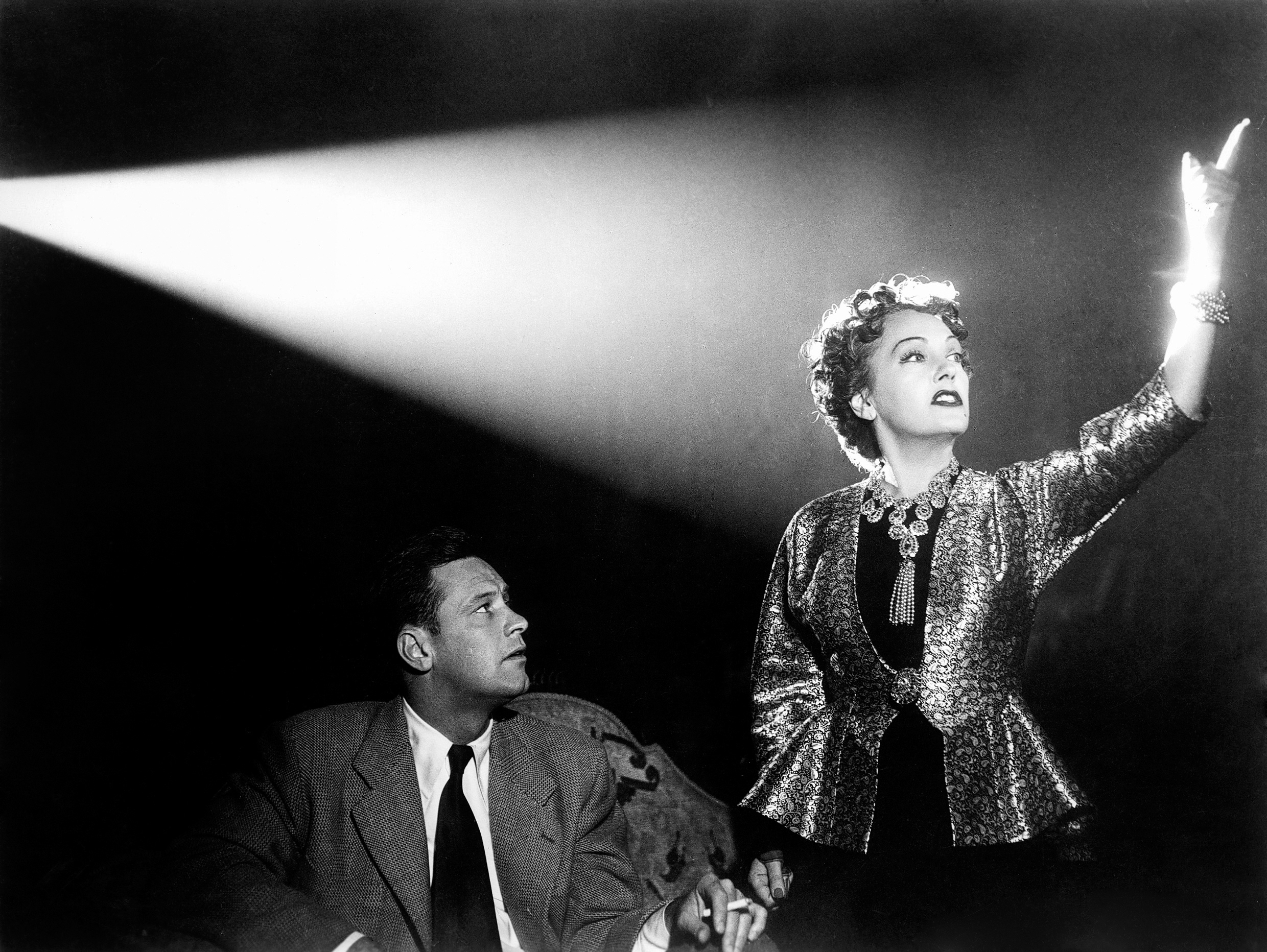
“Those idiot producers! Those imbeciles! Haven’t they got any eyes? Have they forgotten what a star looks like? I’ll show them. I’ll be up there again. So help me! says Norma Desmond. Photo courtesy Photofest


The story of faded glory, youthful ambition, and desperate attempts to hold on to to the Hollywood dream is forever being relived. The script by Charles Brackett and Billy Wilder makes a great story of Hollywood’s long past and eternal present, but it’s the one-liners that pepper our vocabulary today. “All right Mr. De Mille, I’m ready for my close-up,”  says Gloria Swanson as Norma Desmond. Earlier in the movie, reflecting on her silent films, she said, “We didn’t need dialogue, we had faces,” and “I am big, it’s the pictures that got small.” And indeed, William Holden as Joe Gillis is more transfixed by Norma Desmond herself in the scene above, rather than in the movie she shows him.  Sunset Blvd.  continually reflects on itself and on Hollywood history, a hall of mirrors for old movie fans. In the photo above, Norma Desmond shows Joe Gillis a film in which she starred – when she was big. The movie shown is Queen Kelly. Wilder had a wicked sense of humor, Queen Kelly is the movie that made Swanson not so big. She lost a fortune on this self-produced film, never even released in the U.S. due to its outlandish content. She never fully recovered.

Below Erich von Stroheim  playing Max the butler is “directing” her final “scene”, since in the story he was once her director, and who in Hollywood  really was once her director. For the scene Gloria Swanson is dressed as Salome, whose part she once really played, descending the staircase to the theme music from The Dance of the Seven Veils. The director of that movie, Queen Kelly, had been Eric von Stroheim. who Gloria Swanson had fired.


Sunset_Blvd_6


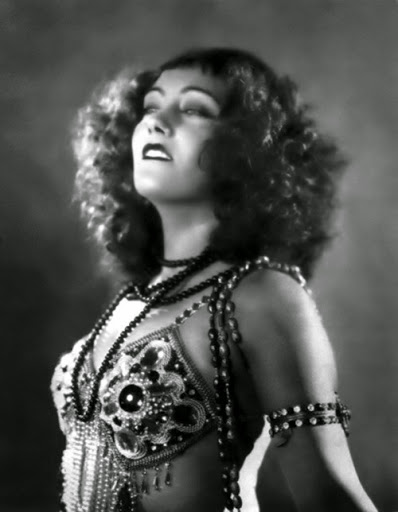
The team of Billy Wilder and Charles Bracket both wrote the script and produced the film for Paramount Pictures. The idea of a Hollywood-themed movie had come to them, one primarily focused on a faded star with hopes of a comeback. The idea of a younger, hungry scriptwriter was a natural fit. The actress to play the role was crucial. Which one, they debated? Greta Garbo perhaps, although she would never consent. Then there was Mary Pickford – uninterested. Perhaps Pola Negri, who was big, but now living as a recluse. Mae West was considered, but didn’t quite fit the image they had in mind, and likely to want to re-write the script. Gloria Swanson was finally considered, the one star that really was considered royalty on the Paramount lot back in the 1920s. Indeed, she married into French aristocracy  in 1925  and became the  Marquise de la Falaise de la Coudraye. Gloria read the script, such as it was early in its draft form in 1949, and agreed to play the part. She was taken aback, however, when she got a call from the Paramount casting director wanting her to take a screen test. “Without me there would be no Paramount Studio!” one can imagine her shouting, as did Norma Desmond in the movie.* But Gloria was somewhat more complacent, saying she had made two dozen pictures for Paramount. Why the need for a screen test? Neither the casting director nor Billy Wilder told her that after all those years away from making movies, they wanted to see how old she would look on film, and what presence she had on screen.  But as it turned out, they would actually have to use makeup to make her look older, but she still had the old magnetism.

As for the role of Joe Gillis the young screenwriter, Montgomery Clift was offered the part, but backed out of the production at the last minute. It seems he didn’t want the role of making love to an older woman.


Sunset Blvd. (1950) aka Sunset BoulevardDirected by Billy Wilder
Photo courtesy of Photofest


The opening shot of the movie shows Joe Gillis, the lead character, dead and floating  up-side down in a swimming pool. He narrates his own story in the third person, Relating how the body of a young man was found in a movie star’s swimming pool early in the morning, He states that it was, “Nobody important really. Just a movie writer with a couple of ‘B’ pictures credit. The poor dope always wanted a pool. Well, in the end he got himself a pool —only the price was a little high.”

Filming the scene above was devised by art director John Meehan. Rather than using expensive underwater cameras, he placed a large mirror at the bottom of a process water tank. The film camera shot down  from the edge of the “pool”and caught Holden, the cops  and the others reflected in the mirror.


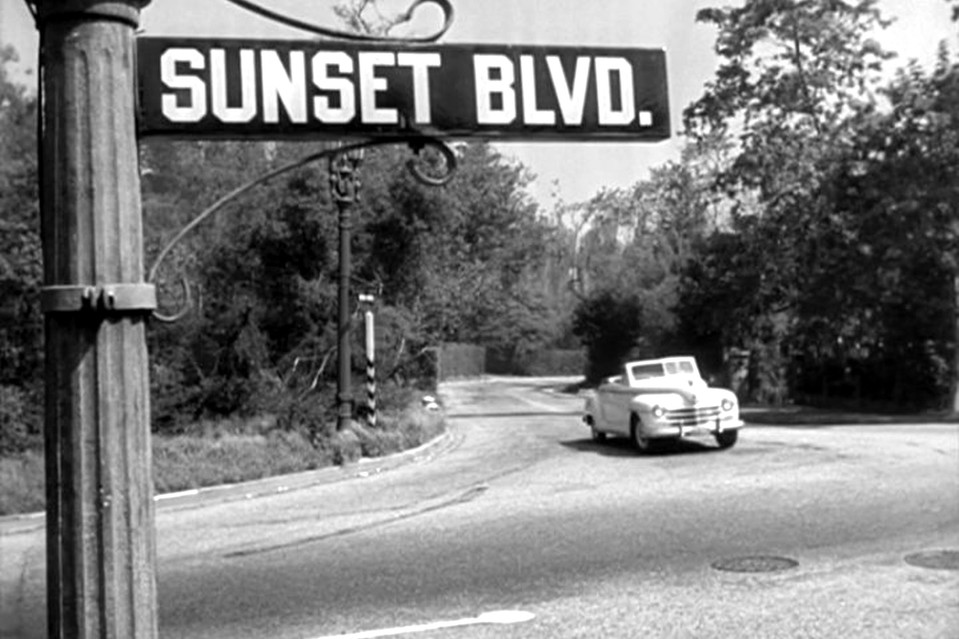
Joe Gillis switches to the first person narrative when earlier in his story he is still alive, typing out a screenplay in his crummy apartment on Ivar Street in Hollywood. He’s trying desperately to sell a screenplay to make some money to pay his next car loan payment, one step ahead of the car-repo men about to tail him. He goes to the Paramount studios to meet a producer. There he has no luck, especially when Betty Schaeffer, a script reader played by Nancy Olson, pans his script. He even asks the producer for a loan but gets nowhere. He goes to see his agent and asks for a loan from him and gets the brush-off. Soon he’s spotted by the repo-men and speeds down Sunset Blvd.


Sunset Blvd escape

It’s by trying to outrun the car-repo men that Gillis ends up turning into a driveway off Sunset Boulevard  and into an old garage, where the clues were mounting that he was entering  into the Twilight Zone.

sunset-boulevard Isod

Inside was an old Isotta-Fraschini,  the kind of car that one doesn’t drive, but is chauffeured in. “It must have burned up ten gallons to the mile,” narrates Gillis. Although this one needed some cleaning, the leopard-skin upholstery showed him that it was no ordinary car.


Sunset Blvd. Mansion


Joe Gillis thought he’d just leave his car there and skip town, giving up trying to make it as a script writer in Hollywood. But he thought he’d take a look at the mansion, figuring it had to be abandoned. “It was a a great big white elephant of a place. The kind crazy movie people built in the crazy Twenties,” he said. He compared it  to Miss Haversham’s in Great Expectations.

The Twilight Zone beckons, as a woman calls out to him, imperiously asking why he has kept her waiting so long. Max the Butler calls him in, expecting an undertaker come to take care of the necessities for Madame’s deceased “pet” chimpanzee. It’s after a few minutes of wordplay and shock that Gillis begins to recognize the woman, after she wants to throw him out for not being the undertaker, and he delivers the line about “…you’re Norma Desmond…you used to be big.” And since this is really a film noir about Hollywood, everyone has a racket. She shows him her piles of manuscripts for her Salome “comeback,” he tells her he’s really an expensive scriptwriter that could polish up her sludge pile for $500 a week, and she starts to see a handsome  live-in companion, and Max had it all figured out   at hello.

Things are all cosy for a while, and Gillis slips into becoming a kept man. Only he  starts sinking into the feeling of an age gone by. This is symbolized by Norma’s friends that come over for a bridge game, the “Wax works,” Gillis calls them. They are played by Buster Keaton, that genius of silent-film comedy, in 1950 not yet rediscovered, Then there’s H.B. Warner, who played Jesus Christ in the DeMille King of Kings in 1927but in 1950 was more recognized as the drunk druggist Mr. Gower in It’s a Wonderful Life.  And perhaps the most forgotten star of all, Anna Q. Nilsson, the first Swedish beauty of the silver screen, who started her motion picture career in 1911, and due to a severe accident had a long interruption, but resumed acting late culminating in Seven Brides for Seven Brothers.


Sunset_Blvd_4


Norma realizes she needs to start putting some spark in Joe’s life. Maybe a big  New Year’s Eve party, with plenty of champagne and music, only with no guests so she can have Joe all for herself and tell him how much she needs him and loves him. Joe’s life flashes before his eyes and he tells Norma that he has a life of his own, and maybe even a girl he loves. Their disagreement ends in a slap, which convinces him to leave, and in rainy weather he goes to his friend Artie Green’s party, where he again  sees Betty Schaeffer. She’s Artie’s girlfriend, but they have a strong attraction for each other. Joe plans to move in with Artie, making a call to Max saying he’ll collect his things in the morning. That’s when he finds out that Norma has tried to kill herself, and so he returns to the Mansion.

Norma perks up with his concern and return. Later with an unexpected but unanswered call from Paramount, she decides to visit the studio.The visit with Max driving them in the Isotta through the old main gates is classic. The worshipful reception of Norma/Gloria by the old-time studio hands and C.B. DeMille himself is a high-spot of the film. This element was added to the script after Billy Wilder witnessed for himself the reception Gloria Swanson received at the Paramount lot when filming of Sunset Blvd. began.


Paramount Studio Sunset_Blvd_1950_25

The visit to Paramount  also provides an opportunity for Joe to visit the writer’s room, and there to see Betty Schaeffer again. They agree to work on a story together, for which Joe must get out of the mansion at night for their rendez-vous

One night Joe and Betty stroll through the “New York” set on the Paramount lot. Here she tells him about the nose job she got in order to land film roles. After that they liked her nose but not her acting,


Sunset_Blvd_5
Photo courtesy Photofest


And of course they fall for each other. There is a great kissing scene on the 2nd story balcony of the old writer’s building. It was shot from a crane, with Billy Wilder and the cameraman at their level. Down below were the other crew members, among which was William Holden’s wife Ardis. As Nancy Olson related at the TCM Classic Film Festival screening of Sunset Blvd. in 2010, Billy Wilder told her and Holden that they should keep kissing until he told them to stop. He said he didn’t know how the scene would need to be edited. So they kissed, and kissed, and kissed some more. And they kept on kissing, until finally  they heard a shout from  down below , “cut goddammit!” It came from Ardis, Holden’s wife.

Things get serious between Joe and Betty, and they want to make plans, only this is a film noir, and we’ve already seen where it ends. Norma discovers their joint script one night and in jealousy phones Betty and spills about Joe’s situation. When Betty shows up at the mansion to see if it’s all true, there’s no hiding the rest of the story. That’s when Joe tells her he’s bound to Norma Desmond on a long term contract with no options. He escorts Betty out. Then tells Norma he’s leaving. As he gathers his things, leaving his eighteen suits and eighteen dozen shirts and platinum keychains she bought him, just packing his old things and typewriter, he tells her there will be no comeback movie for her at Paramount, that they only wanted her car, that Max was writing all her fan mail, and that no, he won’t stay. So she follows him, saying, “No one leaves a star,” and, “You’re not leaving me.” And as he makes his way towards the garage she shoots him – once – and twice more, as he falls into the pool.

Its early the next morning, and the film comes full circle, with police, photographers, the news, and all sorts of people hovering around. And there’s that pool again. The one Joe Gillis always wanted. He’s narrating his own story again, and now thy’re fishing him out of the pool. “Funny how gentle people get with you once you’re dead.”  But as a writer, even a dead one, he almost had the last word on Norma Desmond: “What would they do to her? Even if she got away with it in court – crime of passion – temporary insanity – those headlines would kill her: Forgotten Star a Slayer –Aging Actress –Yesterday’s Glamour Queen…”

Inside, Max tricks her out of her bedroom by telling her the cameras are ready.  Max at the bottom of the stairs, Are the lights ready?  Quiet everybody!  Are you ready Norma?

“What is the scene she asks?”  “This is the staircase of the Palace,” says Max. “Camera. Action!” he says. She descends the staircase in a trance, At the bottom of the staircase she stops, too happy to continue with acting the scene, then asking an imaginary Mr. DeMille if she can say a few words, then  saying,

“….You don’t know how much I’ve missed all of you. And I promise you I’ll never desert you again, because after ‘Salome’ we’ll make another picture and another. You see, this is my life. It always will be. There’s nothing else – just us and the cameras and those wonderful people out there in the the dark…All right Mr. DeMIlle, I’m ready for my closeup.”


Sunset_Blvd 7

And if you’ve seen it a million times like me you can hear Franz Waxman’s musical crescendo closing out the scene.

                                                                   THE END


This last scene is the reason why Sunset Blvd is a masterpiece. Norma Desmond may have been considered a  faded movie star, but she was a star and a performer to the end. She had lived the life of a movie queen and never gave up the role. She dressed up – never totally in style but always chic. Her fan mail may have been fake but that would not have changed her. She knew what she had accomplished, she was once and always a star.  If she were around today she would be flocked by old movie fans. In this role Gloria Swanson had transcended the role and infused it with her own persona and her own glorious stardom. At a wrap screening for Paramount’s stars, it was said that Barbara Stanwyck wept as she kissed in reverence the hem of Gloria Swanson’s silver lame gown.

William Holden also makes this movie work. As co-star Nancy Olson stated at the TCM Film Festival in 2010, Holden made the movie during a personal dry spell, drinking heavily himself and facing the taste of desperation that breathed down Joe Gillis’s neck. Years later he stated that this was his favorite role. After Sunset Blvd., just like the principal star, Holden himself made a comeback. The film was ranked the 16th greatest of all-time by the American Film Institute, and the Library of Congress placed it in the National Film Registry as one of the 25 landmark films of all-time.

Edith Head designed the costumes for Sunset Blvd. When she had first started as a sketch artist at Paramount in 1923, Gloria Swanson was studio royalty. When Swanson returned from France after marrying the Marquis de la Falaise de la Coudraye, Edith Head was just one of the Paramount employees told to throw flowers as the couple drove onto the studio lot. Although Edith had now come a long way, she was still in awe of Gloria Swanson. This was especially the case as Swanson had always been a clothes-horse and very particular about her dress, and owning her own garment company. On her return from France in 1925, Swanson had also brought back fashion and costume designer Rene Hubert.

The look of Norma Desmond, and the role of the costumes in her characterization, was of someone that had only a hint of the old styles of Hollywood. She was certainly no Miss Haversham. She dressed smartly every day and wore clothes appropriate to the occasion and the time of day, even if she stayed mostly at home. When Joe Gillis first visits, she is wearing a hostess dress, a popular early 1950’s  combination skirt and pants outfit.


Swanson1


Above is Miss Head’s costume sketch for Swanson’s opening scene as Norma Desmond. When you look closely you’ll notice in the movie, as in this design sketch, that the outfit has the pants worn under a hostess dress. The liner fabric was changed twice in the design phase,  from the plaid fabric to a floral print and finally to the leopard print in the final production.

Edith designed a stylish ensemble that Norma wears for her Queen Kelly screening with Joe, shown as the first photo in this post.  It is a brocaded top with a cut-away peplum, dropping lower at the back. it is worn over a simple black dress and top, accessorized with a beautiful over-sized necklace.


Swanson2


Above  is Edith Head’s costume design sketch for Norma Desmond’s visit to the Paramount Studio and visit with Mr. De Mille. The final costume was modified. Gloria Swanson had always been fashion conscious. She suggested the feathered hat instead of the headpiece above as a way to emphasize her movie-role ties to an earlier Hollywood. Edith Head designed Swanson’s wardrobe for Norma Desmond as being someone still chic, but with a hint at her old glamour days. Below is the final costume used in the film’s Paramount studio visit.


Swanson3


For her final scene, Edith Head designed  a simple costume for Norma’s Salome , a black gown with a sequined chiffon wrap, a hint of Gloria Swanson as the Salome of 1925 as seen below, back when they had faces.


Sunset Blvd Bohemia Gloria Swanson Salome


*Idea originated in Sam Stagg   Close-Up on Sunset Boulevard. New York: St Martin’s Pess, 2002.


Views: 915

THE WIZARD OF OZ: COSTUMING A CLASSIC

The Wizard of Oz  movie had its 75th anniversary in August 2014, and to commemorate the milestone, Warner Brothers re-released this classic in 3-D. For the occasion the movie was digitally re-mastered, and for the IMAX and 3-D release, each frame of the film print had to be depth-mapped and rotoscoped to maximize the viewer experience. In this post the movie’s production is summarized and the backstory on the costume designs is brought to life here.  This post will cover the Adrian-designed costumes for The Wizard of Oz, and the fabrication and wearing of the costumes and the related make-up of the actors. These relics from the movie have since reached celestial values. If you’re old enough, like me, you will probably wish you had attended that historic MGM auction in 1970 to buy them when they were relatively cheap. Although the Ruby Slippers at the auction, popularly thought at the time to be the only pair, did sell for $15,000. This was the highest price for any MGM auction item. Their story since the movie was made in 1938-39 is itself fascinating.  But as Glinda the Good Witch says, “It’s always best to start at the beginning.”


OZ group
Photo courtesy Photofest


The movie is based on the classic book published in 1900, The Wonderful Wizard of Oz, written by L. Frank Baum and beloved by children long before it became a movie. It had in fact already been made into two previous movies, one in 1910 and another in 1925 which starred Oliver Hardy as the Tin Woodsman.  It had also been a popular Broadway musical in 1902 that toured the country. In all these versions, although the story might change, the look of the characters and the costumes were based on the original W.W. Denslow illustrations for the book. 

In 1935 Samuel Goldwyn bought the movie and stage rights, but never produced anything. But after Walt Disney’s Snow White and the Seven Dwarfs became a big hit in 1937-1938, the children’s fantasy became a hot property again. MGM bought the rights from Goldwyn and began producing the classic in 1938. Eyeing its potential, MGM would spare no expense in the production. 

Oz Denslow
W.W. Denslow illustration for “The Wonderful Wizard of Oz”


Mervyn LeRoy was assigned to produce the movie, with Richard Thorpe as the original director and Adrian creating the costume designs. Although Shirley Temple was considered ideal for the role of Dorothy, it was MGM’s own Judy Garland that got the job, and in the end it was a perfect choice. Some of the key characters began with different actors in the roles: The Tin Woodman started out with Buddy Ebsen playing the part, and indeed he was a unique dancer. The Wicked Witch was to be played by Gale Sondergaard. But early in the shooting with Buddy Ebsen, the aluminum powder on his face gave him a very serious lung problem from breathing the metallic makeup. He was hospitalized and subsequently replaced by the Vaudevillian and movie actor Jack Haley. Adrian dressed Gale Sondergaard in the iconic black gown and hat, although both pieces were adorned with sequins. Gale looked just too glamorous, and pretty, despite her make-up. A “hag” type look was deemed more suitable, and the strong-featured Elizabeth Hamilton was selected instead, her image exaggerated with facial prosthetics and green make-up. Although Ebsen was then considered to play the Scarecrow, it was Ray Bolger that got the part, a rubber-legged song and dance man ideal for the part.

Oz_DorothyWardrobeShot
Although most of the film was in Technicolor, test photos like this one were in black & white. This early dress was solid blue with accents.


Judy Garland as Dorothy wore only one dress for the entire movie. Still, it took several tries before that one dress was decided upon. One dress design was in a  light  blue color with no trim, another had gingham trim at the bodice and skirt, still another was a darker solid blue with tiny bows on the bodice. Judy’s hair color and style also varied in the early tests, from red to blond to her final auburn color. After a couple of weeks of filming, the results didn’t satisfy Le Roy, and so he replaced Richard Thorpe with George Cukor, who because of his prior commitment for directing Gone with the Wind, was only temporary. Victor Fleming would succeed him as director of  The Wizard of Oz.  As it turned out, Cukor would in turn be replaced by Victor Fleming as the director of GWTW. Thorpe’s chosen look for Dorothy was also changed, this in favor of the classic Adrian design of a blue and white checked pinafore with the off-white puffed-sleeve blouse. Judy’s long curled wig was also eliminated. It had been an attempt to hide her breasts (Dorothy was a young girl in the book, Judy was 17), which was accomplished by wearing a flattening bra, just one of the uncomfortable costumes worn by the cast.

Oz early wardrobehair test of Judy Garland as Dorothy Gale

The photo below shows Judy in the classic pinafore, with Toto. It was the first color scene in the movie, just as they enter Oz and she exclaims, “Toto, I have a feeling we’re not in Kansas anymore.”

Oz was one of the big Technicolor movies.  The use of this filming method created several difficulties. Technicolor cameras were owned by the Technicolor company, and their use was tightly controlled. Colors had to be approved by the Technicolor consultant, which drove Adrian mad due to the costume color modifications that had to be made. White did not work at all due to the strong glow it gave. Thus Dorothy’s white blouse had to be dyed to produce a sort of dirty white.  Technicolor also required very bright lighting, so banks of overhead arc-lights were used, as many as 150 on the biggest sets. This created intense heat which exhausted the actors in their heavy costumes and make-up. Ironically, this same intensive lighting requirement for Technicolor has made it feasible to render the movie into 3-D.

OZ judy & toto
Photo courtesy Photofest

Glinda (the Good Witch) is played by the wonderful Billie Burke. Adrian designed his favored shoulder-emphasis in her gown, with the pouffed shoulders actually resembling wings. In the book Glinda wore a white gown decorated with silver stars. Instead Adrian had to change the white to a dusty rose color in order to satisfy the demands of  the Technicolor company.

Oz Glinda & Dorothy

And then there were the Ruby Slippers. They serve a key role in the plot and are one of the most  iconic costume pieces in cinema history. In Baum’s book The Wonderful Wizard of Oz, Dorothy’s shoes are silver. Adrian thought that red shoes would have more pizzazz in the Technicolor film, and would  help to emphasize their importance to the story. Several types of red shoes were tested, including one pair with the curled-up toe that was called, the “Arabian slippers.”  Adrian believed that only red sequins gave the right sparkle. So now finding the right method of attaching sequins to shoes was experimented with. The shoes were not built from scratch. The pumps with their French heels were purchased from the Innes Shoe Company of Los Angeles, Hollywood, and Pasadena, in several pairs, and reportedly dyed red. Several pairs were necessary in order to account for wear and tear and a pair for Judy’s stand-in. In the MGM Wardrobe Department, embroiderers sewed red sequins (nearly 5000 sequins) onto shoe-formed  red sllk georgette, which was then sewed onto the red faille pumps. Somewhat later Adrian added the red bugle beaded and rhinestone jeweled bow which was also sewn onto each shoe of the regular pairs. Scarlet-colored felt was also glued onto the soles of some of the ruby slippers, most notably those seen on the dead Wicked Witch of the East, and the soles of others were painted red. The blue silk socks were also a great addition, especially as compared to the dark knee socks previously tested. The Ruby Slippers have their own crucial role as Dorothy is told by Glinda to tap her heels together three times and say, “There’s no place like home.” in order to return.

Oz Dorothy & slippers

The Tin Man was costumed in close proximity to the book’s illustrations, as was the Scarecrow except for the blue color of his jacket. Neither tin nor metal was actually used, but rather a starched and lined buckram, which was a common material used in making durable book covers. This in turn was painted silver. Jack Haley’s make-up was made up of a layer of cold-cream, white foundation, and then aluminum paint. This was modified from the disastrous first version used with Buddy Ebsen. Ray Bolger’s make-up for the Scarecrow was a partial rubber mask to simulate burlap. He went through dozens of these masks during the course of production. His costume was a green jacket and brown pants, stuffed at several places with raffia to resemble straw. Every couple of days these costumes had to be cleaned by a process of  hand-sponging them during the evening, if not replacing them altogether.

OZ Judy tin man scarecrow
Photo courtesy Photofest

The Cowardly Lion in the book was indeed a lion, so the costume was made of real lion skins and mane. Projecting ears were added, and Bert Lahr wore a prosthetic lip and jowls, and separate lion mittens. The costume also had interior padding, which made it weigh about 50 pounds. The tail was manipulated during the filming by a wire attached to a sort of fishing rod, handled by a crewman from above. All the heavily made up and costumed characters suffered because of the heat. Bert Lahr complained the most, saying he could only eat his lunch using a straw.

Oz Lion

As a starting point, the Art Department envisioned the world of the tiny Munchkins as being close to the ground. Thus Adrian incorporated the theme of flowers for their costumes: appliqued and embroidered flowers; flower-pot hats; leaf decorations, and the like. And all the Munchkins’ costumes would be made of felt for softness. He emphasized their smallness by designing over-sized collars and large vests and hats. As in the book, various Munchkins had titles and defined jobs: the fiddlers, the heralds, the soldiers, the First Townsman, the Coroner, the Mayor, and others. For the Commander of the Army, Adrian used a rose for his spurs and a birdcage hat. 

The characters were played by dwarfs (little people as they liked to be called), with some child actors used as well.

OZ munchkins
Photo courtesy Photofest

The costumes in the Emerald City of Oz were of course all green. Thus shoes, stockings, dresses, and coats were green. This gave much extra work for the Wardrobe Department since stockings, shoes, and coats were not available in green, and so these costume parts all had to be dyed, which took several days to accomplish. For the shoes, they were spray-painted, which meant the insides and the soles had to be taped off. One of the highlights of the movie was the Emerald City Beauty Shop, where Dorothy was beautified as well as the other lead characters. Here Adrian was finally able to add some fashion styling to the beauticians’ wardrobe.

OZ_Dorothy_beauty parlor
Photo courtesy Photofest

The basic exterior look of the Emerald City of Oz was the result of a brainstorm of Cedric Gibbons, the Head of the Art Department, when he was discussing the problem of designing a unique look for Oz with production designer William Horning. Gibbons was looking at a German studio photo of a group of glass beakers when he had the idea to use these elements for the look of Oz. The idea was to make the beakers green and turn them upside down in a grouping. This ended up giving a unique look to Oz as seen from far away.

OzThe Kingdom of OZ

Frank Morgan played key roles throughout the movie. His job was very laborious as he had to be fitted for each costume and tested in a variety of make-ups, wigs and mustaches. In different make-up and costumes he played the roles of Professor Marvel, the Doorkeeper of Oz, the Guard at the gates of the Wizard’s palace, a horse-drawn wagon cabby, and of course the Wizard of Oz himself. An unbelievable yet true story surrounds the frock coat he wore as Professor Marvel. Not finding an appropriate tattered-looking coat in the Wardrobe Department, Wardrobe personnel were sent searching in a second-hand (not yet called vintage) clothes store. There they picked up a rack of appropriate-looking coats. Frank Morgan, Victor Fleming and the wardrobe man picked out one that had the right look of well-worn gentility. Later on Frank Morgan looked inside and discovered an interior  label with the late L. Frank Baum’s name on it. The coat’s authenticity was later verified by Baum’s widow Maud as well as his tailor.

Oz Morgan

The heavily made-up face of Bert Lahr as the no-longer-cowardly Lion expresses the joy that this movie has given millions of people.  The Wizard of Oz is a national treasure.

OZ Lion & Wizard
Photo courtesy Photofest

And The Wizard of Oz was also a musical, with music by Harold Arlen and lyrics by E.Y (Skip) Harburg.  For the first time ever, a non-animated feature film would have its music “pre-scored,” that is the songs were conceived as an integral part of the script. What would The Wizard of Oz be without Over the Rainbow? Yet this song was almost eliminated from the movie, when some MGM execs doubted that anyone would go for a girl singing in a barn yard. Arlen and Harburg pleaded for the song. After some initial negative previews it was almost cut again. Arthur Freed, then an assitant to producer Mervyn Le Roy,  finally threatened to quit if the song was cut. The final decision was made by Leo B. Mayer, who said it would stay.

The Wizard of Oz Actually lost about a million dollars after its initial realease in 1939, after distribution and advertising costs were added to the $2,777,000 production costs. It  was first shown on television on November 3, 1956. Since then its popularity has grown and it is now the most-watched movie in the history of film. The movie made life-long celebrities of all of its main cast members. Judy Garland won a miniature Oscar for Best Performance as a juvenile performer. Oscars were also won for Best Score and Best Song (for that barnyard classic, Over the Rainbow). There was no Oscar for Adrian, as no Oscars were awarded  for costume at that time, when the classic costume designers were in their prime.

One pair of Ruby Slippers have been on exhibit  at the Smithsonian Museum for many years, where lines are usually formed to see them. Another pair has recently been donated to the Museum of the Academy of Motion Pictures Arts and Sciences in Los Angeles, where no doubt they will be the chief attraction. Their current value is $2,000,000.

The inked #7 pair of Ruby Slippers originally found by Kent Warner

Several excellent research resources exist on the Wizard of Oz production, including:

*Aljean Harmetz, The Making of the Wizard of Oz

*William Stillman and Jay Scarfone, The Wizard of Oz:The Official 75th Anniversary Companion

* Rhys Thomas, The Ruby Slippers of Oz

Views: 3131

BEHIND THE SCENES AT THE OLD MGM WARDROBE

At the biggest and busiest movie studio of Hollywood’s Golden Age, hummed the most productive studio wardrobe department in movie history. At its most complete in the  1960s, it had some 300,000 costumes in its wardrobe storage – not counting those it had already dicarded in previous decades. MGM regularly produced over 40 moves every year, with its costume designers and wardrobe department producing the costumes for most of them. By comparison, today’s studios make 10-15 movies a year, and of course studios no longer have in-house costume design and fabrication capabilities.

MGM facade

The facade of the old MGM Studio and its original entry gate on Washington Blvd as it looked in 1936 is seen above. The Wardrobe Department was located near Washington Blvd and what the studio called 1st Street. Men’s Wardrobe was located elsewhere and costumes were also stored in various locations.  The Wardrobe Department had a manager who ran its day-to-day operations, separate from the costume design staff.  A view to the three-story department is seen in the photo below. In addition to the glamorous part of movie costumes, post-production they would have to be laundered or dry-cleaned, and then inventoried and hung up in the high racks. Bolts of fabrics of all kinds would have to be kept on hand or custom ordered.

MGM ladies wardrobe 1

MGM went through several designers after its beginning in 1924-25. The studio hoped to capitalize on the name of Erte in 1925, but he didn’t last. Andre-Ani, Max Ree, and Rene Hubert all did fine work but none lasted long at the studio. Gilbert Clark managed to last longer, but was as temperamental as the divas he dressed. This didn’t work for Garbo. So when Cecil B. DeMille came to make movies for MGM and brought his costume designer Adrian, he soon found his designer under contract to MGM. Starting in 1928, every movie that Garbo starred in was designed by Adrian, as was every Joan Crawford movie until 1941 when Adrian left to start his own fashion line. He also designed the costumes for Jean Harlow, Hedy Lamarr, Lana Turner, and Katharine Hepburn.

MGM+Adrian
Adrian liked to paint his costume sketches on his sofa, using the end table to lay out his water colors.

Seen below is a group of MGM wardrobe ladies at work.  The Adrian sketch shown and the costume on the dress form are for Greta Garbo in Grand Hotel. As was the case for all leading ladies, Garbo had her own custom-sized dress form (padded to her dimensions).

MGM Wardrobe_Garbo Sketch from Grand Hotel

Hannah Lindfors, a cutter-fitter, is shown below. She  translates the designer’s costume sketch into muslin pattern pieces, which are then used to cut the chosen fabric. In this case its for a Dolly Tree design for Rita Johnson. When Adrian left to start his own fashion business, Hannah Lindfors left with him as his cutter-fitter.

MGM Cutter-Fitter

Several lace-makers are at work below on the bridal veil for Helen Hayes for the movie White Sister, 1933. It took two weeks to make.

MGM lace workers

Two Wardrobe ladies are working on the embroidery for a costume for Romeo and Juliet, starring Norma Shearer, Leslie Howard and John Barrymore. Adrian and Oliver Messel designed, and Wardrobe fabricated , some 1250 costumes for the film.

MGM+Romeo

Cutter-fitter Inez Schrodt is seen below working on a gown for Marie Antoinette, 1938. The film starred Norma Shearer and Tyrone Power. Some 2500 costumes were used in the film, and Adrian designed 36 costumes for Norma, which was a long-standing record until Cleopatra of 1963.

Inez Schroedt & Marie Antoinette gown

Jane Halsey is seen below resting on a “leaning-board” during the filming of The Great Ziegfeld, 1936. The costume was made of bugle-beads and weighed 102 pounds. The leaning boards were heavily padded with cloth – less for comfort but as to prevent snags to the costumes.

MGM 8

Wardrobe ladies below are at work on Lana Turner’s costume in Ziegfeld Girl, 1941. The film had completely different but equally magnificent costumes as The Great Ziegfeld, which Adrian also designed.

MGM 7

Greer Garson has a stitch repair done to her costume by Vicky Nichols on the set of Mrs. Parkington, 1944. Her costumes were designed by Irene, who had taken over as head designer from Adrian. Irene was at MGM from 1942 until 1948. She was joined by Helen Rose and then Walter Plunkett. Irene Sharaff and Robert Kalloch also worked there for a period, and Gile Steele and  J. Arlington Valles designed men’s costumes.

MGM+Greer+and+wardrobe+lady

The Wardrobe Department kept most all of the costumes it made. These were re-used in other films, and often modified. Costumes are being pulled here and placed on a rack for some film. All of these costumes were sold in the MGM auction of 1970.

MGM Wardrobe racks

This section of shelving shows Roman style helmets, most likely with other armor pieces further inside the shelves. Similar but smaller shelves housed thousands of shoes.

MGM waedrobe helmets

Shelves and bins of shoes of all sizes and styles were also available for stock use. After years some of these were neglected and placed in more recessed areas, where no doubt the, several pairs of the Ruby Slippers from the Wizard of Oz were later found. Only one pair made its way to the MGM auction of 1970. It set the record for the highest priced item at the auction: $15,000. At recent auctions, pairs of the Ruby Slippers have fetched around $2 million.

Lana Turner is shown below with a costume sketch for one of her costumes and the actual costume from The Prodigal, 1955. Herschel McCoy designed the costumes for the film.

MGM+Lana+and+fitter

By 1955 when The Prodigal was produced by MGM, the heyday of the studio system was over. Leo B. Mayer had been replaced as head of the studio by Dore Schary. The Consent Decree forced by the US Court over an Anti-Trust suit had made studios divest their ownership of movie theaters, and television viewing had decimated movie audiences. Costume designers like Walter Plunkett, who had been working since the late 1920s, had gone from designing for over 20 movies a year back then to designing just two movies  for MGM in 1957.

Fortunately, the legacy of MGM, its movies and the work of its costume designers and makers , and the other artists and artisans of the studio are preserved in the movies for all of us to see and enjoy. These behind the scenes photos show that the work of producing glamour was not glamorous. And in those days film credits did not acknowledge the work of any of them in wardrobe except for the costume designer. This is a small tribute to their work.

READ MORE ABOUT THE STUDIO WARDROBE DEPARTMENTS IN MY FORTHCOMING BOOK:

Views: 2612

EXODUS: GODS AND KINGS – THE NEW EPIC

The history of epic film is rich with the story of Moses and his liberation of the Jewish people from Ramses and the Egyptians, along with the dramatic crossing of the Nile while being pursued. Cecil B. DeMille made two versions of the story in The Ten Commandments, including the famous 1956 version with Charlton Heston and Yul Brynner. Now the epic has been modernized with Ridley Scott’s sweeping direction in the 20th Century-Fox production of Exodus: Gods and Kings. The costumes, sets, and scenery of the production do justice to the biblical epics of DeMille’s day while adding special CGI effects not known in classic film days. With a cast of Christian Bale as Moses, Joel Edgerton as Ramses, John Turturro as Seti and Sigourney Weaver as Queen Tuya, the actors bring this historic drama to life. If you missed it on the big screen, it is out now on Digital HD and Blu-Ray.

To see more behind-the-scenes production content, check out the Exodus interactive site:

Grab it on Digital HD: 


Exodus 2
Conceptual art for Moses for the movie Exodus: Gods and Kings


Ridley Scott is famous for his vision of what style and look the movies he directs will have. One can see that as far back as his first film The Duellists, starting in 1977 and going on to Alien, Blade Runner, 1492, Gladiator, Kingdom of Heaven, and American Gangster, to name a few. Having started out as a cameraman he has a keen eye for how visual details can help tell the story and  set the mood. He has forged strong relationships with his creative team, including costume designer Janty Yates, who won an Oscar for Best Costume design for her work in Scott’s film Gladiator.


Exodus 3
Conceptual art for the character of Ramses II


When Janty Yates got the call asking her to work on Exodus: Gods and Kings, she knew from experience that this would involve a cast of thousands, but her reaction was “I can do this.” But then she found out she had four months to make it happen. That’s when she started waking up every night at 3:15 a.m. concerned about getting it all done – and done to Ridley Scott’s exacting vision. “Research, research, research,” she said about how she started the job.  The original Egyptian sources proved the best resources. “I spent a huge amount of time looking at wall paintings, ”  added Yates. “You can get a huge amount of reference from tombs, temples … even color.”

In an epic of this magnitude, costuming runs the spectrum from providing period dress for some 7000 people, including armor for warring armies, to detailed accessories for the Egyptian aristocracy. This also included jewelry like pendants, arm bracelets, multiple rings, collar pieces, headdresses, ornate belts and aprons. “Everyone wore about 15 pieces,” Yates said.  “Was it blingy?” asked Ridley Scott about the movie. “Absolutely,” he said.

When it comes to costumes from the Egyptian period, the costume rental houses fell short of what was needed. “The last big Egyptian movie  was Cleopatra with Elizabeth Taylor,” Yates said . That movie was released in 1963. But in the early 60s, the tastes ran to bright colors in women’s costumes, and foundation undergarments were used  to  nip in waists and  emphasize breasts, looks no longer considered appropriate for period films.  So Yates pretty much had to start from scratch. For the Egyptians that meant fabricating the costumes , from the palace guards to the principle cast members. For the Hebrews, their rustic linen costumes were historically more functional, made in a basic T-form by Italian costume houses. These  very contrasts in the costumes tell part of the story.


Exodus 6 Queen

Queen Nefertari is played by the Iranian actress Golshifteh Farahani. As a queen, and as one of the Great Royal Wives of Ramses, she wears a royal headdress and all the trappings of her station. Much of the costume design elements came from Egyptian hieroglyphics and wall paintings.


Exodus 7 Queen Tuya

Queen Tuya was another Royal Wife, played by Sigourney Weaver. Ridley Scott told Yates he wanted her “to be little more of a man-eater.”

One of Yates’ favorite costumes to design was for Ramses. His suit of armor was plated in gold.That was also discovered in the wall paintings. She designed one of his helmets  in a rich blue, and shaped like a bees’ nest.  But a gold helmet design was used instead. This alternate design was a better match for Joel Edgerton’s face. Janty Yates loved going over-the-top on his costumes, especially since Ramses II himself  was just such a vain and out-sized character.


Exodus 4 - Ramses

The court costume of Ramses as designed for Joel Edgerton is shown below. The costumes for Edgerton and Christian Bale as Moses were essentially “dresses” so they had to be “butched up” according to Yates. And the colors for Moses had to be made quite different than from Ramses in order to highlight their differences.


Exodus 5 Ramses 2


Exodus 1- Moses

Costume sketches for Moses in Egyptian armor are shown above. The Egyptians used a type of armor called lamellar, which was made of rectangular shaped platelets or scales which were hole-punched and laced together. For the movie the platelets were made of urethane by the UK company FBFX, a supplier of specialized costumes and props to the industry. The material is very light but tough, and it can take a finish that resembles metal. The lightness of the urethane was very functional for all the stunt men in their fight scenes.


Exodus 9


The Egyptian infantry fought mainly with a spear, or a bow, and protected by a shield as well as the loin shield shown in the sketch above and below.


Exodus 8


The costumes in Exodus: Gods and Kings, like all the best costumes in movies, help define character and sets the story in time and place. Here is a visual treat that makes the scenes and the action all the more life-like as a movie experience.  Yates thinks it compares very well to The Ten Commandments, with enhanced special effects and without dated costumes,  saying , “… to make it glorious, that was my mission.”  And in the process another great collaboration between Ridley Scott and Janty Yates was made.


Views: 749

CRIME & PUNISHMENT: ON FILM WITH PETER LORRE


Blogathon Crime and Punishment (1935)_01
The Czech poster for Crime and Punishment


Fyodor Dostoevsky’s novel Crime and Punishment was also the title of the 1935 film. It opens with the prologue: “The time of our story is any time, the place is any place where human hearts respond to love and hate, pity and terror.” The novel is one of the great works of literature, and its  plot has been adapted for many films from the silent era through modern times. Josef von Sternberg directed Crime and Punishment, but he did so for Columbia after having been fired at Paramount after directing  The Devil is a Woman, his last film with Marlene Dietrich. His last two films there had not done well and had caused various problems for the studio. He was going through the motions at Columbia and later spoke unfavorably about the movie, and that Lorre was inappropriate for the role, which has caused it to  have a poor reputation. It was not the sort of glamorous films he was used to making with Dietrich, but Crime and Punishment deserves to have more respect. For one, it was Peter Lorre’s second American film, and virtually his only  lead role as a normal character in an American movie.

josef von sternberg 1939 - by laszlo willinger


Peter Lorre had just come to the United States in 1935, and got a job at Columbia Pictures.  He shared a room with Billy Wilder and they both had to learn English. He had already received strong reviews playing the child murderer in Fritz Lang’s M, and subsequently after fleeing Germany, in England for Alfred Hitchcock in The Man Who Knew Too Much. It was Lorrie who suggested to Harry Cohn that he star in Crime and Punishment, for which he would be willing to be traded to MGM to make Mad Love, which would become his first American film, while waiting.

blogathon-peter-lorre-834x1024
Portrait of Peter Lorre taken for Crime and Punishment


Crime and Punishment is the great Russian story of crime and the power of redemption. It would be virtually impossible to capture the novel in a single movie. But this 1935 film has several qualities. Its acting for one is uniformly excellent for the principal cast of Lorre as Roderick Raskolnikov, Edward Arnold as Inspector Porfiry, Marian Marsh as Sonya, Tala Birrell as Antonia “Toni” Raskolnikov the sister, and Elizabeth Risden as Raskolnikov’s mother.


Crime and Punishment Sonya


Marian Marsh is pictured above as Sonya. There is no doubt that she is meant to be enticing and alluring. A magnet for Raskolnikov in many ways. The story is about Raskolnikov, a university student that has distinguished himself by his theories and understanding about crime and criminals. He has been given an expensive pocket watch for his graduation. He believes his intelligence and moral values puts him above the law. Yet he lives in poverty, eking out a living from his writings. When he learns his family is coming to visit, he goes to pawn his watch. There he sees a young woman, Sonya, given only a ruble for her silver-covered bible and kicked out by the woman pawnbroker. She drops and loses her ruble, and Raskolnikov offers her his money when he learns she is supporting her family.   The prologue was taken as a stylistic cue for the film and its art direction. It could take place at any time, and at any place. No cars are shown in the film to date whether it depicts Dostoesvsky’s time, or the film noir heights of the 1950s. No phones ring, or voice-over narrations explain the existential quagmire of Raskolnikov’s life, but the deep black shadows and contrasting lights, with the recurring bars of his staircases provide a favorite noir trope. And von Sternberg shows frequent shots of Lorre taken from behind, perhaps to make his character more obscure.

blogathon Crime_and_Punishment_


But Peter Lorre is one of those actors that would have been perfect for the silent screen. He conveys every emotion on his face without the need of words: fear; anxiety; disdain; haughtiness; sympathy; love. His sympathy for Sonya and sudden hatred for the pawnbroker, mixed with his belief in his own ability to flaunt the law, takes him back to the pawnbroker, as he needs money again as his family is coming to visit. Only this time he kills her and takes her money.

Blogathon Lorre

Crime and Punishment the novel is the most psychological and existential of 19th century works of literature. The film boils that heavy story down to a proto-film noir, a bleak work about a lonely man in the process of estranging his family – but too smart to care about the trap that is being set for him by a plodding police inspector.


Blogathon Lorre & Napoleon


The image above shows Lorre as Raskolnikov in his humble apartment. But his opinion of himself in not humble, symbolized by the portrait of Napoleon. He sees himself like Napoleon, brilliant and a maker of his own rules. He reads articles about  the crime he has committed, but he knows the pawnbroker was cheating people out of money. He is not enough above the law however for being arrested for not paying rent. There he meets Inspector Porfiry. The Inspector has heard of him and asks his opinion about the likely criminal and so begins his cat and mouse with Inspector Porfiry.


blogathon crime-and-punishment-peter-lorre marian marsh


Marian Marsh plays a beautiful a vision of innocence for Raskolnikov to be lured into wanting to protect and to give away all his money to. In the book she was a prostitute. She is doubly alluring to him for having had to pawn her expensive bible for which she received practically nothing. She is a mix of innocent and guilty.

Raskolnikov is also protective of his sister. He learns that her boss Grilov has forced himself upon her, and she then lost her job. When subsequently she agreed to marry a rich but older and more homely man, Lushin. Raskolnikov mocks Lushin , which breaks up their engagement.


Blogathon LORRE &


An innocent man is brought in and accused of the crime of killing the pawnbroker, This event does not fit in to Raskolnikov’s philosophical scheme.

When the innocent man is arrested, Inspector Porfiry is just as happy to pin the crime on him – he has his reputation to maintain. Later, Raslknikov is appalled when the man even confesses to the crime. This shakes his psychological foundation, and his conscious at having a man punished for a crime that he committed.


Crime and Punishment 4
Edward Arnold as Inspector Porfiry at left, Douglas Dumbrille as Grilov at right.


The Inspector insinuates himself into Raskolnikov’s life. He invites himself to a family dinner, then questions the family members about the crime. Raskolnikov becomes furious and asks him to apologize.


blogathon group

The psychological foundation of Raskolnikov’s life is cracking. Guilt is the cause, hammered by Porfiry and  steeping in his subconscious. His love of Sonya, his sister and mother makes his guilt feel even more acute, especially when he confesses to Sonya and sees her reaction.


blogathon CrimeandPunishment1935a


The theme of Crime and Punishment the novel and the film, is the power of love and redemption to heal the soul – even the subconscious in the grip of past sins and misdeeds. Sonya offers to run away with him. But he decides he will turn himself in to Porfiry and save an innocent man.  Sonya goes with him,  and will follow him to Siberia. Only then does he feel true  happiness.


blogathon crime-et-chatiment


Dostoevsky’s Crime and Punishment has often been the subject of films or film adaptations. It first appeared in a silent film version in 1917 produced by Arrow and  directed by Lawrence McGill and starring Derwent Hall Caine. A German production followed in 1923 titled Raskolnikov, then a Monogram production came out in 1946 entitled Fear starring Warren William. In 1959 Allied Artists produced a version starring George Hamilton.

Perhaps the most unlikely of modern adaptations of Crime and Punishment happened when Paul Schrader directed and wrote the screenplay for American Gigolo. He was influenced by the French director Robert Bresson and especially Bresson’s film Pickpocket (1959), Bresson was also a big influence on the French New Wave. Jean-Luc Godard reportedly viewed Pickpocket ten times. Bresson in his making of Pickpocket was himself influenced by Crime and Punishment. The story elements of the novel used in both films center on a young man who believes that he alone can judge that he is above the law, and that for some people even murder is permissible if it is done for a higher purpose, which he soon commits. Ultimately, he is doggedly pursued by a detective and he is sent to a Siberian prison, followed there by a former prostitute who he has helped, and who in turn helps him to heal. Dostoesvky’s theme was the power of love and redemption. Thus did this theme find its way in the final scene of Pickpocket, when the imprisoned robber for the first time tenderly kisses Jeanne, a young woman he had previously scorned, from behind bars and says, “…to come to you, what strange journey have I had to take.” This scene was repeated in American Gigolo. And in this more chaste version of Crime and Punishment, 1935, Peter Lorre and Marian Marsh are seen together as Raskolnikov and Sonya, where he is turning himself in, eyes heavenward, yet still with their future together.


crime and punishment 7


Views: 428

THE DUELLISTS: RIDLEY SCOTT’S NAPOLEONIC THRILLER

Let it not be said that men are not the equal of women as duelling divas. There is no better proof than in the film The Duellists, with its noble heritage of being based on a Joseph Conrad short story titled The Duel, which in turn was based on a true story about two members of Napoleon’s cavalry that carried on a series of duels with each other that lasted 20 years , from 1794 to 1813.

The Duellists, made in 1977, was the directorial debut of Ridley Scott. It was made for Paramount under a  tight budget of $900,000, and Scott was offered certain actors to work with. Those who accepted to be the principals were Harvey Keitel as the hot-headed Cavalry Hussar Gabriel Feraud, and Keith Carradine as Hussar Armand D’Hubert. Keith Carradine almost didn’t accept since his song I’m Easy was a hit in 1976, and had received the Oscar for Best Original Song for Nashville. He was  thinking maybe the singer-songwriter life was calling him.

The panoramic scene below is not a duel between the protagonists, but rather of Feraud at left just before he seriously wounds the nephew of the Mayor of Strasbourg, which sends Carradine/D’Hubert on orders to arrest him for duelling, which precipitates their years-long grudge match of duels.

The Duelling Divas Blogathon is hosted by Lara at the Backlots blog

Duellists 6

This opening scene is very reminiscent of the opening pastoral duelling scene of Stanley Kubrick’s Barry Lyndon, made only two years before and undoubtedly a stylistic influence on The Duellists. The scene below takes place at Mme. de Lionne’s salon, where D’Hubert is about to tell Feraud he is under arrest.

The costumes were excellent in the film, designed by Tom Rand and fabricated in Italy. The military uniforms were very accurate.  The Hussar’s uniform of the period consisted of a fur-trimmed pelisse jacket with rows of buttons, frogging and loops, worn over the left shoulder. The torso was also covered with a dolman that also featured rows of frogging and a two-toned barrel sash. the trousers worn inside  cavalry boots. Belted sabers were accessorized with the black leather “sabretache” pouch that featured the Napoleonic eagle. The hat was the tall leather shako with brass chin straps, emblems, and feather, and later the bearskin hat. The colors of the uniforms depended on the regiments. D’Hubert at left wears the colors of the 3rd Hussars, Feraud at right that of the 7th Hussars. Historically all hussars were light cavalry and assumed to be impetuous. They used sabers, pistols and carbines as weapons.


Duellists 8

D’Hubert’s visit, official business or not, was perceived by Feraud as an insult and the cause for their 1st duel. In filming these fight sequences, Ridley Scott operated the camera himself, using a hand-held camera and getting close to the action, dodging sword swings as he shot. Scott had been a maker of commercials before turning filmmaker, so he felt comfortable operating his own camera, talking directly to actors  while filming, and paying attention to the details of set design. He stated this made is easier for him to be thrifty while still achieving his goals in filmmaking.

The duel below ends with Feraud being wounded, but his girlfriend saved him by jumping on D’Hubert and severely scratching his face.


duellists 1

The photo below shows a close-up of the hussar uniform and hair-style. The French hussars’ hair was worn long, somewhat typical of their Hungarian origins. It was braided at the side, this to add protection from saber cuts to the cheeks. The back was worn in a knotted queue, offering more protection for the back of the neck. Mustaches added extra panache. The red and white barrel sash belt was largely decorative – its origin was that of a rope to tether horses.


Duellists 9

The scene below was shot from the interior of a village building that was transformed into a café. Scott filmed the movie mostly in France in the Dordogne area, No sets were used, only real buildings and outdoor settings. This worked for its authenticity and also to save money. Carradine as D’Hubert sits looking outside the window with his friend and fellow lieutenant Lacourbe played by Alun Armstrong. Also in the scene is the great actress Diana Quick, playing D’Hubert’s girlfriend Laura. Outside the window, the dreaded Feraud’s friend and second can be seen walking down the street, who also sees D’Hubert. Thus, the second duel is set up.


Duellists 10


The second duel  is also set in a pastoral landscape, on a lush carpet of grass using epees as weapons. The duel is quick, as Feraud runs his blade into D’Hubert’s chest. The wound is not mortal, but quickly ends this encounter. He is seen lying on the ground surrounded by the other hussars in the image below.


Duellists 7 Alan Armstrong

Laura nurses D’Hubert back to health, yet they separate as he prepares for another duel. This one is fought to exhaustion with swords inside of a vaulted barn. Ridley Scott shot this sequence himself as well with a hand-held camera. He used some rudimentary special effects, using chicken wire on the walls that had been wired to a 12 volt battery, so when Keitel’s sword blade hit the wall sparks flew (and Keitel got jolted). The duel ends in a draw, as both men are bloodied and can barely lift their sabers, they lock arms and collapse on the floor.


Duellists 3rd

In 1806  D’Hubert is now in Lubeck, with the rank of Captain. Again with  Lacourbe in a tavern, he is spotted by Feraud, who has also achieved the same rank. Fighting a superior officer would be grounds for a courts martial . Feraud immediately challenges him to another duel, this time on horseback, a “tribute to the cavalry,” D’Hubert is told, who finds it hard to take this connection seriously.

The duel will be made by cavalry charges with sabers. D’Hubert is nervous, remembering his previous chest wound. When the two pass each other in their “joust,” Feraud is struck on the head and knocked off his horse. D’Hubert celebrates by jumping his horse over a cart piled high with hay and then races down a country lane.


Duellists 11

The Napoleonic wars continue and D’Hubert and Feraud find themselves in the disastrous Russian campaign. In the frozen terrain they are about to shoot each other with pistols when cossacks attack them, so they empty their pistols  at the cossacks instead.

After the wars D’Hubert, now a General, returns to a more peaceful life. He visits his sister and her two sons. The sons, shown in the picture below, were played by Ridley Scott’s two boys: Jason and Luke Scott.


Duellists 4

D’Hubert’s sister Leonie, played by Meg Wynn Owen, introduces him to the beautiful Adele, played by Cristina Raines. Cristina just happened to be Keith Carradine’s girlfriend at the time. In the scene below he proposes to her. She can’t keep from laughing, however, as according to Scott, Keith’s horse had an erection during the shooting. Erection or not, the horse should have gotten a Best Supporting Actor Award for continuously nudging Keith in Cristina’s direction.


Duellists 12

In the Conrad story D’Hubert wants to settle a final duel with pistols before he marries and so writes a letter to Feraud. In the movie Feraud’s  friend and second, Chevalier played by John McNery, now in humbled condition as is his companion, finds D’Hubert and asks for satisfaction on Feraud’s behalf – for a now long-forgotten reason. In fact unknown to Feraud, D’Hubert had saved his life by intervening when Feraud was put on a death list when the new Bourbon king came back on the throne. Feraud and many Bonapartists were in disfavor at best with the new royal regime.

As they had left off in Russia, pistols would be the weapon: two pistols; one shot in each in open country.


duellists 13

True to his character, Feraud is the more tempetuous, firing more quickly in their game of cat and mouse. D’Hubert is left with the last shot, which he can take at close quarters. Instead, he spares Feraud’s life, on condition that he forever leaves him in peace.

The last film shots are of Feraud overlooking the hills and a river. He is expressionless, and we are left to draw our own conclusion about his state of mind. Like his Emperor’s, his ultimate battle was a defeat. And the monarchy and its aristocracy, that they both fought against, were back in power in France and safe on their thrones throughout Europe.


Duellists 2


One can view The Duellists as an anti-war film, or one depicting the futility of war as represented by the stupidity of duelling. It was in any case an auspicious beginning for Ridley Scott. While it had limited distribution in the U.S., it won a Best First Work at Cannes where Ridley Scott was nominated for a Palme d’Or, and was nominated for Best Cinematography and Best Costume by BAFTA. One can see in this film Scott’s clear focus on setting and his characters’ often  sharp delineation in that world. The chiaroscuro of his cinematography is both beautiful and effective, and a hallmark of his film Blade Runner.

There is no more iconic story of dueling divos than The Duellists, but it is also fundamentally a story of forgiveness.


Views: 1254

THE 10 WILDEST COSTUMES IN FILM HISTORY

Hollywood movies have a rich history of wild and outrageous costumes. My list of the “Ten Wildest” must be prefaced. I did not include show girl, chorine, or musical number costumes. If I had, Adrian would likely have taken all ten slots in his costumes from The Great Ziegfeld, and Ziegfeld Girl.  I also did not include fantasy, fairy tales, superhero, and science fiction movies, which precluded the great costumes from movies such as The Hobbit series, Snow White and the Huntsman,  the Star Wars series, and the fabulous Edward Scissorhands costume.

I did include the  costumes from historical characters on film, and from masked balls, which often depict historical characters, although with a bit of fantasy. Quite a bit as we’ll see later.  The costumes skew to the 1930s. As has been written about elsewhere, so much energy was channeled into the movies as a release from the Depression and other societal pressures. This was especially true for film costume design. Well represented below are the great designers of that field: Adrian; Travis Banton; Walter Plunkett; Edith Head, and Irene Sharaff.

Your own list may be very different than mine. There are many costumes out there to discover. But to start out 2015, here’s my ten wildest costumes of the last century on film. They are arranged in chronological order.


Costume Wild Salome Nazimova

1) Alla Nazimova in SALOME. Costume design by Natasha Rambova, 1923

The Biblical story of Salome, the daughter of Herod II and the original femme fatal, is told in this film, based on the Oscar Wilde story. The sets and costumes were designed by Natasha Rambova, the wife and manager of Rudolph Valentino. Even Erte was an admirer of Rambova’s style. She was born in Salt Lake City, and was not Russian. She did dance in the ballet and was very talented. She hired Adrian in New York to design costumes for Valentino, and was responsible for bringing him out to Hollywood with them. This costume was inspired by the book illustrations of Aubrey Beardsley.


Costume wild Evelyn Brent_ Slightly Scarlet_gray shades_001

2) Evelyn Brent in SLIGHTLY SCARLET  Costume design by Travis Banton, 1930

Evelyn Brent plays the unwilling accomplice of a jewel thief in Paris and the French Riviera in this caper. She looks like a jewel herself in this Travis Banton “hostess gown.”  The fabric was a sapphire blue chiffon, encrusted with crystal bugle beads. She wears no brassiere, definitely pre-code.


Costume wild Mme Satan 2

3) Kay Johnson in MADAM SATAN Costume design by  Adrian, 1930

This is a C.B. DeMille directed movie, which has to be seen if only for its Zeppelin Ball and “Ballet Mecanique” sequence. Kay Johnson plays a staid housewife that is losing the attention of her husband and so takes on the persona of “Madame Satan” at a party on a dirigible. The costume designed by Adrian had red sequins on the interior of the cape, flame-cut fabric that went up the bodice, flame shaped gauntlet gloves, and the horned mask. The velvet was not black but a dark purple that registered better on the black and white film.  See below.


Costume wild Madam Satan 1


Costume wild Garbo_Mata Hari_color_006

4) Greta Garbo in Mata Hari. Costume design by Adrian, 1931

Certainly one of the most amazing costumes in movie history is this outfit made for Garbo in Mata Hari, its pants were made of gold mesh, the bodice of spruce green colored glass beads, and crystals, with a metallic scull-cap, jeweled-belt, and a bugle-beaded, long-trained skirt. Yet the costume was backless, a typical asymmetrical flourish of Adrian’s, but one showing Garbo’s vulnerability as Mata Hari the spy. Fifteen women worked three weeks to make the costume.


Dietrich Coq feathers

5) Marlene Dietrich in SHANGHAI EXPRESS. Costume design by Travis Banton, 1932

Marlene Dietrich plays “Shaghai Lilly” in Von Sternberg’s film, playing a regular rider on the Shanghai Express, living by any means possible in China for a woman of her beauty and wits. Travis Banton dresses her to perfection for the role, the picture of allure that only the silver screen and the glamour photography of the era can capture. The black coq feathures, skull cap, and veil, concentrates attention on her face, yet surrounds it in mystery. Still the confidence and the power of glamour radiates from within. The long  string of pearls add sparkle over the black dress. The gloves and bag are Hermes.


Costume wild Hepburn Christopher Strong

6) Katharine Hepburn in CHRISTOPHER STRONG Designed by Walter Plunkett, 1933.

Katharine Hepburn played an aviator in this story of complicated love affairs within the Brittish upper classes. This was her first starring role. Here she wears this stunning Walter Plunkett designed costume to a party, The costume’s theme is “the silver moth” taken from “The White Moth,” an early working title for the film. The costume was made from small silver-metallic squares like an airplane would be, and she had a skull cap/helmet with the antennae of a moth. Indeed, she flies too close to the sun.


Costumes Wild Cleopatra 34 1
Photo courtesy Photofest

 7) Claudette Colbert in CLEOPATRA, Designed by Travis Banton, 1934.

Cleopatra was one of the Cecil B. DeMille spectacles, and despite its age, holds up well in its visual and storytelling qualities. The sets are amazing, though very much influenced by the styles of the 1930s, but the same holds true with the later Cleopatra and the influence of the 1960s. Travis Banton’s costumes are magnets for the eye, with essentially simple form-fitting, 1930s silhouettes adorned with Egyptian-chic  accesories. Banton had a series of arguments with Claudette Colbert over the designs for her costumes.  She found them too revealing, with disapproving comments written all over his beautiful costume sketches. He left a second set of costume sketches for her approval, with instructions that she had better either like these or slit her wrists. The next day Banton waited and waited, only to have them returned streaked with dried blood. Furious, Banton left the studio and went on a binge, not returning until several days later when studio head Adolph Zukor called him personally and mediated the situation.


Color Cleopatra_1934_3


Costumes wild GWTW
Photo courtesy Photofest

8) Vivien Leigh in GONE WITH THE WIND, Designed by Walter Plunkett, 1939.

This is one of the most iconic costumes in movie history. Although the curtain dress was part of the original novel, Plunkett designed it with  much panache, adding its one sided capelet and huge tassled belt. Plunkett picked a green velvet to match Vivien Leigh’s eyes, although he had parts of it faded to look like authentic curtains. Vivien’s hat of velvet and black coq feathers was made by Mr. John. Scarlett wears the costume in crucial scenes as she goes asking for money from Rhett and then runs into Frank Kennedy.


Costume wilf Grace-Kelly

9) Grace Kelly in TO CATCH A THIEF, Designed by Edith Head, 1955

The exquisite Grace Kelly does not play hard to get opposite Cary Grant in this movie where we are kept wondering, is he or is he not a jewel thief, operating on the French Riviera (jewel thieves and the Riviera have a long history in film). This movie has some of Edith Head’s best costumes, and the one above is a knockout. It is worn at a costume party and the plot’s climax, and Grace is wears the mock Marie Antoinette 18th century gown of gold lame, complete with golden birds and a golden wig.


Costumes Wild Cleopatra 63
Photo courtesy Photofest


10) Elizabeth Taylor in CLEOPATRA, Designed by Irene Sharaff, 1963.

The last “wild costume” comes from another Cleopatra, and probably the most lavish costume film in history. In fact the production and marketing costs of $44 million (in 1963 dollars) for the movie nearly bankrupted 20th Century-Fox, and halted production on several of the studio’s movies. The number of costume changes for Elizabeth Taylor still holds a record at 65 costumes. The gold costume above and below was made of seed pearls, gold bugle beads, and sequins, including  a cape made of 24-carat gold -covered leather strips, made to look like the wings of a Phoenix.

costume wild Cleopatra Liz
Courtesy 20th Century-Fox


If only we still had such Masked Balls.


Views: 1154

NORMA SHEARER: 1st SCREEN SYMBOL OF SEXUAL LIBERATION?

There were more far more beautiful actresses than Norma Shearer in the 1920s and 30s, and more pretty and flirtateous ones: the “It Girl” Clara Bow, or the beguiling Louise Brooks at Paramount. Gloria Swanson was there too, all of them representing the allure of sex without ever engaging in it.  At MGM, the hot looks of Joan Crawford, Greta Garbo, and Jean Harlow were magnets in the roles they played. Garbo was the  foreign exotic, made to seek redemption for her sexual transgressions, even in her Pre-code films.   And at Warner Brothers, gangster movies and women going bad were part of the wave that came with the Great Depression. We forget the revolutionary roles of Norma Shearer in the Pre-Code era, drowned amidst her later sympathetic and well-known roles in films such as Romeo and Juliet and The Women, and even Marie Antoinette.  But it was Norma Shearer that broke the barrier of the “everyday” middle-class woman on screen that had sex just because she wanted to, or in her ground-breaking role in The Divorcee (1930), to get back at her cheating husband.

Norma Shearer Hurrell

Norma Shearer had already  been making films at MGM for several years, she in fact starred in the studio’s first film, He Who Gets Slaped, in 1924. Although many of her roles were good, she was ambitious and wanted to push the envelope. She wanted roles that were daring, and wanted to break out from the “good girl” stereotype -roles that would later be considered liberating to women. That she was married to MGM production head Irving Thalberg was both a blessing and a curse. She had access, which in Thalberg’s case was exremely hard to get. On the other hand he didn’t think she was glamorous or sexy enough for these kind of roles. But Norma was undeterred. So she turned to two consumate artists. The first was photographer George Hurrell, who took a series of photographs of her in poses that, while sexually suggestive, were done in a manner that enhanced her best features and remained in good taste. These photographs surprised and ultimately convinced Thalberg that she had the qualities to take on the role for the film The Divorcee. The second artist was Adrian. He had just been made Head Designer at MGM in 1928, where in his first year he designed her costumes in A Lady of Chance, and the following year for The Last of Mrs Cheyney. His designs emphasized her best features while compensating for her less than ideal figure, all while making her look chic and alluring.  In The Last of Mrs Cheyney her role is such that one is kept guessing as to whether she is a “good girl” or a “bad girl.”  She plays a jewel thief – but with a twist. She is shown below with Basil Rathbone. The dynamic is that he’s from the upper-class and has no compunction about playing the field. But what rules apply to women? In 1929 there was still the basic elements of a code, but questions were being asked and doubts were being raised.


Norma Last of Mrs. Cheyney

With The Divorcee the year later (1930) a big leap had been made by Norma and the movies.  This is the script she had lobbied her husband for. It was based on a book by Ursula Parrott, Ex-Wife.  Norma described the role as  “…very strong, almost ruthless. Perfect for me.” And perfect for getting her out of the too-refined and too sweet roles she had been playing for years. Adrian takes her through a make-over with obvious results. She is transformed into a woman of the world – and into a very modern woman – no longer an ingenue of the 1920s. Her husband has been cheating on her. So she gets even by cheating on him – with his best friend.  When he finds out, has a fit, gets drunk and decides to walk out on her, she has her own angry speech, “I’m glad I discovered there’s more than one man in the world, while I’m young and they want me. Believe me, I’m not missing anything from now on. Loose women are great…From now on you’re the only man in the world my door is closed to!”

Below Norma Shearer never looked better – dresssed by Adrian in The Divorcee and out on the town with Robert Montgomery.  Norma won the Best Actress Oscar for her role. She attended the Academy Awards ceremony in an Adrian gown she wore in the film, the first recorded designer gown at the Oscars.

Norma Shearer and Robert Montgomery The Divorcee2

Soon after making The Divorcee, Norma made Let Us Be Gay, 1930, In this story too she plays a wife with a cheating husband, Only she has two children, and to emphasize the make-over central to the plot, Norma begins the movie wearing no make-up and in frumpy clothes. Three years later she is visiting her rich friend Mrs. Bouccicault, played by Marie Dressler.  “What have you been doing since I left you in Paris, she asks?”   Norma playing Kitty Brown, replies, “Oh different men for different months.” Kitty is now the well-dressed sophisticate, the magnet for every man in the entourage, including her former husband who happens to be there, shocked at her transformation. He is courting Mrs. Boucci’s granddaughter, and that’s why Kitty has been invited to lure him away from her.

The photo below shows Norma Shearer as Kitty Brown, the center of attention in her black Adrian gown. Seated at left is Hedda Hopper. This famous gossip columnist was a fashion plate in her day, and always loved the way Adrian dressed her in her movie roles.


Norma Shearer let-us-be-gay

Norma’s most daring role followed in Strangers May Kiss, 1931. In this movie she doesn’t believe in marriage. She has one boyfrend, played by Neil Hamilton, that travels with her, but is secretly married and then goes off on a trip without her. Another man loves her, played by Robert Montgomery, but she’s not in love with him. Stung by her boyfriend’s betrayal – she travels to Europe, where she will experience all the other men she fancies. And does she. The character Norma plays is openly sexually aggressive, and there are many references to that in the film. “She changes her men with her lingerie…” one man says.  In the scene pictured below, she tells Robert Montgomery, “I’m in an orgy –  wallowing – and I love it.”

The movie’s ending is rather implausable, and belies the point of the theme, but Pre-Code or not, social conventions and the MGM’s need to maintain a certain stature for Mrs. Thalberg prevailed. As it was the studio was getting a lot of flack by some critics, and  within the then Studio Relations Committee that reviewed movies  as part of the Production Code,  it represented: “…the initiatory stages of the degeneration of a people.” as one member put it.*

Norma Shearer and Robert Montgomery

Adrian’s gowns were defining  more and more Norma’s elegant but beguiling roles.  Norma especially liked the sleek nightgowns he designed for her, that she would wear without undergarments while filming. “Norma’s nighties” these would be called, and she would ask for them in all her movies.

Norma Shearer 1931

For A Free Soul below, Norma wears an Adrian-designed nightgown made of a tangerine-colored velvet with a train. Both train and the cord at the waist help accentuate her figure.


Norma Shearer_A Free Soul

A Free Soul, 1931, throws in more complexities in the plot. Based on the book by Adella Rogers St. John about her own life, Norma plays the daughter of defense attorney Stephen Ashe, played by Lionel Barrymore. Their relationship is troubled by his alcoholism. Norma’s steady boyfriend is played by Leslie Howard, an upper-crust type. One of Ashe’s clients is the criminal Ace Wilfong, played by Clark Gable in his first starring role. Norma as Jan Ashe is stricken by Ace’s animal magnetism and sexual attraction. In a famous scene from the movie, where they are together in his apartment, she cuts him off when he is talking about himself, reclining on his couch, she says, “Come on, put ’em around me.”


Norma and Clark A Free Soul

A Free Soul won Lionel Barrymore a Best Actor Oscar, mainly based on his stirring courtroom speech in the film. Norma was nominated for Best Actress but did not win. Clark Gable, not yet with mustache, was all over the fan magazines. The “Put ’em around me” scene caused more problems with the Studio Relations Committee and the American Motion Pictures Producers. The movie had managed to put both free sex and gansters in a good light.

Norma’s next movie, and her last “Pre-Code” film was Riptide, 1934. Here she plays a woman with a full romantic history but is married to an English Lord for convenience, played by Herbert Marshal. While he is off on a trip abroad she decides to go on one herself to Cannes on the Riviera, on the invitation of his aunt. But there she just happens to run into an old flame played by Robert Montgomery in the same hotel, and in adjoining rooms. The sex is is not overt here and Norma is not on the make. Robert Montgomery is the aggressor, which leads to the plot twists.

At this point in the cycle of her Pre-Code films, Norma Shearer had  blazed a trail of “sexual liberation.”  In that regard, and in its acting, Riptide is the weakest of her movies. It must also be said that she had become the lightening rod for the forces of censorship in the U.S. (and in other countries). This had also become an issue for Irving Thalberg. After a heart attack and a forced temporary leave, and against his will, he was replaced as head of production at MGM.

Riptide achieved the peak of glamour for Norma Shearer.  Adrian’s designs achieved Norma’s ultimate desires for sophisticated yet sexy dress, as shown in the following two images.


Norma Shearer_Riptide


Adrian’s designs for Norma Shearer often use a long skirt or gown that accentuate a flowing look for her otherwise short-legged figure. He also used fabrics and beaded material that hugged her figure to accentuate the slimness she worked hard to achieve.


Norma Shearer_Riptide_2


Enough protest had been taking place around the country, led by some of the churches and others, that the Production Code Administration took control of film content on July 1, 1934. Joseph Breen was its head, and there would be serious changes in how films were made. Naturally, anything to do with sex, especially women’s roles, would be scrutinized. Anything in the script would not likely be approved, anything that made it to the film would be subject to cutting. And anything that referenced “sex” that was not of the approved kind would need to have the character (the woman) punished as a consequence or made clear that the person  was a harlot. Criminals would also always be punished at the end of the story.

Norma Shearer had served a pivotal role in depicting women and their ability to choose their sexual identity and liberties, fleeting as it was. Actresses before her were sexual icons without overtly exercising sexual expression. Contemporaries like Greta Garbo that did make those choices on film were exotics that paid the price or sought redemption at the end. And others including Joan Crawford, Jean Harlow, and Barbara Stanwyck played women on the make or from a tough upbringing. Norma Shearer represented the middle and upper-middle class, and thus, many women fantasized about themselves while seeing her on film. For that she was more dangerous.

The next film Norma made would set the tone for her several films to follow: The Barretts of Wimpole Street, 1934 based on the life of Elizabeth Barrett Browning. This was followed by Romeo and Juliet, 1936,  and then Marie Antoinette, 1938.  They were all beautiful romantic films, though two had tragic endings – endings natural to the story, but certaily in compliance with the Production Code Administration for any transgression that was committed by the leading actress.


Norma Shearer and Tyrone Power
Norma Shearer as Marie Antoinette with Tyrone Power who plays her lover Count Axel de Fersen


* Vieira, Mark.  Sin in Soft Focus: Pre-Code Hollywood.New York: Harry Abrams, 1999, p 52.

See also LaSalle, Mick. Complicated Women: Sex and Power in Pre-Code Hollywood. New York: St.Martin’s, 2000 for an excellent discussion of women’s roles in Pre-Code films.

Views: 1571

Gail Patrick: The Forgotten Star

gail_patrick 2

Gail Patrick was the perfect contrast for such sweet and adorable blond stars as Carole Lombard in My Man Godfrey and Irene Dunne in My Favorite Wife. She could also play the perfect bitch, roles that didn’t seem to phase her. She knew that with her tall, lithe figure, she was also the perfect model, and she need never be intimidated in any room, especially with a Baccalaureate degree tucked away in her purse pocket.

This post is part of the Classic Movie Blog Association’s Forgotten Star Blogathon.

Gail Patrick was born  Margaret LaVelle Fitzpatrick in Birmingham, Alabama, on June 20, 1911,  She had an older and a younger brother, and thus grew up competing for attention. Her family was very social, and  in the Southern manner, talk and storytelling were part of the environment. Gail received a B.A. from Howard College where she also served as dean of women for a period. She pursued a law degree at the University of Alabama, but after entering a publicized nation-wide contest by Paramount Pictures to play the “Panther Woman” in Island of the Lost Souls in 1932, she gave up her academic life and went Hollywood.  She lost the role to Kathleen Burke, who she nonetheless befriended. It turned out to be a good thing for Gail, her friend Kathleen later related to her that she could never get another good role after being identified as “the Panther Woman.”


Gail Patrick Death_Takes_Holiday_1934
Frederick March at left with Gail Patrick as a blond in Death Takes a Holiday, 1934, Photo courtesy Photofest

Gail was nevertheless placed on contract at Paramount Pictures for $50 a week. Not a large sum by movie star standards but a lot of money compared to what many people were earning during the Depression. She was given several uncredited roles in 1932-1933, and with her legal education she quickly negotiated her salary to $75 a week, and added a clause in her contract that she would not pose for cheesecake photos. In 1934 she played a minor role in a more important film, Death Takes a Holiday, shown above. It was directed by Mitchel Leisen and starred Frederick March and Evelyn Venable. In what would later be remade as Meet Joe Black.  This was Gail’s first film to be dressed by the talented Travis Banton. From here on, with the exception of a few westerns, Gail Patrick would be a fashion plate on film.


Gail Patrick 3

In the photo above Gail Patrick does her best dark Marlene Dietrich imitation in a publicity shot for Mississippi, 1935. The movie has apparently never made it to video or DVD, but was a classic pairing of W,C Fields and Bing Crosby. Crosby played Gail’s beau, until he didn’t meet up to her Southern ideals, whereupon he was relegated to her sister Joan Bennett’s attentions. This was one of eight movies Gail Patrick made in 1935.

Gail’s tough sister act in Mississippi must have made an impression on director Gregory LaCava, who cast her as Cornelia Bullock, the tough and jealous socialite sister of Carole Lombard in the wonderful My Man Godfrey. As Cornelia she tries her best to get William Powell as Godfrey fired since she couldn’t win his attention. As devious as Cornelia is in the movie, and in the best use of characterization, one can  be redeemed, and here we see Gail/Cornelia transformed by the nobleness of Godfrey.


Gail Patrick My Man Godfrey 1936
Carole Lombard, William Powell, and Gail Patrick in My Man Godfrey. Photo courtesy Photofest


Gail married Robert Howard Cobb in 1936, the first of her four husbands. He was the owner of the famed Brown Derby restaurant in Hollywood. The second was the derby-hat shaped restaurant on Wilshire Boulevard accross from the Ambassador Hotel, and its famed Coconut Grove lounge. All were famous as hang-outs for the stars. Alas , all are now gone. One lasting tradition, the Cobb salad, invented at the Brown Derby and named after its owner.

Gail played a leading role in a little known film titled Her Husband Lies  (originally The Love Trap), from 1937. The story is based on the character of the notorious gambler and gangster Arnold Rothstein (characterized in Boardwalk Empire). Gail plays a nightclub singer married to Spade Martin played by Ricardo Cortez as the Rothstein character. He swore to his wife he was going straight but due to a variety of circumstances involving his younger brother, he gets sucked back into the underworld of gambling. Gail goes back to singing torch songs at the nightclub, and film noir starts early in this movie from the late 1930s.

Gail was dressed by Edith Head in this film as Travis Banton was having his problems with alcohol. Edith would soon be made head designer at Paramount. She followed his advice though, “When in doubt, trim in fur.”

Gail Patrick_The Love Trap
Gail Patrick in Her Husband Lies.

Gail’s next big role was as a society beauty in Artists and Models, in 1937, co-starring Jack Benny, Ida Lupino, and Richard Arlen. The movie was a Paramount take-off from the Shubert’s Broadway Revues of the same title, the musical and chorus-girl themed shows popular in the 1920s. The central plot involved the production of the Artists and Models Ball. Jack Benny as the Ball Chairman had offered the “Queen of the Ball” role to his girlfriend Ida Lupino, a working class girl. But then he meets society girl Gail Patrick playing the part of Cynthia Wentworth, selling tickets for a charity benefit, and he offers her the “Queen of the Ball” role. The plot hinges somewhat on who will win out, but the real action is in the models and the musical numbers, including numbers by Louis Armstrong and Andre Kostelanetz. A real controversy ensued from the film’s showing in the South due to the  musical number with Martha Raye, this due to her apparent interacting with the black musicians and  dancing and gyrating in a style of the “negroes.”*

With all the emphasis on fashion and the musical stage costumes, Travis Banton got serious and produced some beautiful costumes for the film


Gail Patrick Artists And Models1937
Artists and Models – Left to right: Leroy Prinz; Ida Lupino; Raoul Walsh; and Gail Patrick. Photo courtesy Photofest.

Her next film was another classic and one of my favorite movies, Stage Door (below), directed by Gregory LaCava, whom she had worked with in My Man Godfrey, but this time at RKO. Before The Women, this was the women’s film par excellance. Its cast is a good indication of that: Katharine Hepburn; Ginger Rogers; Eve Arden; Lucille Ball; Ann Miller; Constance Collier; Andrea Leeds and of course Gail Patrick. Moreover, they are all roomates at the Footlighters Club, a boardinghouse for aspiring actresses in New York, supporting (or competing with) each other for roles on the stage. Constance Collier serves as a reminder of how it can all go bad, a sort of Norma Desmond without the mansion. This is also the model movie for delicious wisecracking and the women’s dialogue talking all over each other. The instant antagonism between roomates and polar opposites played by Katharine Hepburn and Ginger Rogers reflected their own rivalry at RKO, and the boarding house rivalry between the Ginger Rogers and Gail Patrick characters is feisty to say the least, spiced up with the wisecracks of Eve Arden and Lucille Ball,  some of it apparently improvised. Only the Andrea Leeds character is innocent, a victim of the system. Competing for roles and sometimes competing  for the same men, Stage Door shows the highs and lows of the stage life.

The women’s wardrobe for Stage Door was designed by Muriel King, a freelance costume designer and fashion designer.


gail-patrick-in-stage-door-(1937)

Several B movies and smaller roles followed: Mad About Music; Dangerous to Know; Wives Under Suspicion; King of Alcatraz; Disbarred; Man of Conquest; Grand Jury Secrets; Reno; and The Doctor Takes a Wife, where she plays the “other woman” to Loretta Young.


Gail Patrick My_Favorite_Wife_1940_

And then came My Favorite Wife, 1940, where the “other woman” role got really close to importance, as the groom was Cary Grant. As character Nick Arden he was finally free to marry Gail playing Bianca Bates after his wife was declared dead after seven years of being missing at sea.  The couple drive off to a honeymoon at a Yosemite lodge, unfortunately the same spot of his first honeymoon, where the now just-returned first wife played by Irene Dunne goes looking for him.  Plenty of surprise, embarrassment, and consternation is had by all.  And then Cary has to make a decision between her and Irene Dunne. Maybe Randolph Scott that Dunne dragged home with her from the shipwreck island where they lived together will complicate things sufficiently, it certainly did with the movie’s censor. Now if only his wife will take him back, but which one?

This was another RKO film, directed first by the talented Leo McCarey, but following a serious car accident Garson Kanin finished directing the film. Costume designer Howard Greer, formerly at Paramount, who now had his own fashion business based in Los Angeles, designed the women’s wardrobe.


gail patrick william powell 1


By 1941 Gail had perfected the “other woman” role, as she was once again cast the part, this time as William Powell’s old flame in Love Crazy. In this film he’s married to Myrna Loy, and they are about to enjoy their 4th wedding anniversary when the mother-in-law visits, slips on a carpet, sprains an ankle and prolongs her visit. It’s his job now to go mail an important letter since his wfe was out, whereupon, low-and-behold, he runs into his old flame Gail in the elevator, finding out that she has just moved into the building with her husband. Sure enough, the elevator breaks down and he ends up with a concussion, but with some special nursing by Gail as seen above, a spark is relit (enough for the plot amyway). There are complications galore, although everyone ends up with their respective spouses, Gail Patrick is all fun in this movie, and as usual beautifully dressed.

No costume credit is given in the film, a time of transition between several designers coming and going at MGM. But my eye says it was designed by Adrian.


hit parade 1943

Gail starred in the Tales of Manhattan in 1942 and Hit Parade of 1943, as seen above. She appeared in several more films through the mid 1940s, but none with any major roles. She retired from acting in 1948, her last film being The Inside Story, produced at Republic Pictures, one of the “Poverty Row” studios.

In 1947 she married Thomas Cornwell Jackson, her third husband. He was the literary agent for Erle Stanley Gardner, who wrote the Parry Mason mysteries. Gail and her husband produced the TV show based on the book series, which ran from 1957 – 1966. For a few years previously she also designed a line of children’s garments.

Gail Patrick died in 1980 of leukemia at age 69. She bequeathed $1 million to her sorority  Delta Zeta, the largest gift it has ever received.


Gail Patrick 1


*American Film Institute, Catalog of Feature Films. Artists and Models.  http://www.afi.com/members/catalog/DetailView.aspx?s=&Movie=5196

Views: 1610

HOLLYWOOD COSTUME: THE ACADEMY’S EXHIBITION

LA Hollywood Costume 4

After opening in London’s V&A Museum in 2012, traveling to Australia and two American cities,  Hollywood Costume finally comes to Los Angeles, where the vast majority of the films and costumes  that make up the exhibition originated. The idea and impetus for the exhibition also started in Los Angeles, well Beverly Hills, with Deborah Nadoolman Landis, costume designer and current professor,  founding director, and Chair of the David C. Copley Center for for the Study of Costume Design at UCLA. It is altogether fitting that the exhibition be in Los Angeles, but even more significantly, that it opens on the site of the future home  of the Museum of the Academy of Motion Picture Arts and Sciences. The museum has been in the planning stages for years, but is now solidly in the works and set to open in 2017 in a major reworking of the former May Company department store on Wilshire Boulevard in the “Miracle Mile,” a site leased from the Los Angeles County Museum of Art.  Hollywood Costume the exhibition is open now through March 15, 2015.


LA Hollywood Costume 1A

Some 150 costumes are on exhibit, ranging from the silent era through Hollywood’s Golden Age to last year’s Oscar nominee The Dallas Buyer’s Club. Iconic costumes are included such as Marilyn Monroe’s “subway dress” from  The Seven Year Itch, Judy Garland’s pinafore from The Wizard of Oz, and the Academy Museum’s recently acquired treasure, the “#7” pair of the Ruby Slippers, the ones in the best condition out of all those known to exist. Other wonders include Marlene Dietrich’s sequins and crystal-studded gown and cape from Angel designed by Travis Banton, Norma Shearer’s court dress from Marie Antoinette designed by Adrian, Jean Hagen’s flapper dress from Singing in the Rain designed by Walter Plunkett, and Marilyn Monroe’s sequin decorated and fur-trimmed gown from Some Like it Hot, and Ginger Roger’s mink skirt lined in sequins designed by Edith Head.

Hollywood costume VA SomeLikeItHot
Marily Monroe’s dress from “Some Like it Hot.”


The exhibition as conceived by Deborah Nadoolman Landis was to put costume in the context of the character, the actors, the plot and the total movie experience. So sections of the script are on view, as are screens with projections of the actor’s faces. The multimedia approach has filmed interviews, monologues, and film clips. The costume design process is explored through scripts highlighting personality clues, costume sketches, budget breakdowns, and fittings.


LA Hollywood Costume 3

Above is pictured a blown up section of a script. The costumes shown are from Kim Novak in Vertigo and Joan Crawford  in Mildred Pierce, designed by Edith Head and Milo Anderson respectively.


LA Hollywood Costume 5

The Indiana Jones costume is well recognized. It was designed by Deborah Nadoolman Landis herself.


LA Hollywood Costume 6 jpg
Photo KABC

Some other well recognized costumes are on view. The eye-popping red gown at left was worn by Julia Roberts in Pretty Woman, Barbara Streisand’s costume in Hello Dolly, at left and Funny Lady at right, and in the background is Ginger Rogers in Lady in the Dark, and at right Kate Winslet in Titanic.

LA Hollywood Costume 8

Marilyn Monroe’s “subway dress” is shown above. It was designed by Travilla, who designed many of her film costumes. It was sold in the famous Debbie Reynolds auction in 2011 for $4.6 million, minus commission, by Profiles in History.

Larry McQueen Hollywood costume V&A Angel Travis Banton

One of the most fantastic costumes from Hollywood’s Golden Age is Marlene Dietrich’s gown from Angel, 1937, designed by Travis Banton. It is a marvel of Hollywood studio craftsmanship.  It was made from chiffon and embroidered with thousands of hand-sewn silver and gold  sequins and Austrian crystal beads, which took weeks to make. The stole is trimmed in Russian sable. It was lent by Larry McQueen who took great pains to restore it.


Superhero costumes are shown on display at the Hollywood Costume exhibit in Los Angeles

Men’s costumes, and the blockbuster superheroes, are represented as well, including Superman, Batman, and Captain America.


LA


Deborah Nadoolman Landis introduced the exhibition opening on October 1st.

Matt Petit / ©A.M.P.A.S
Michelle Monaghan views the exhibition during the opening event. Matt Petit / ©A.M.P.A.S

If you are in the Los Angeles area in the next several months and can book a ticket, go a see it. This is one of those very special exhibitions that will not likely come around again.


Views: 389

60s A-GO-GO

Sixties fashion image The striking and continually fascinating aspect of mid-to-late 1960s fashion is that it so closely reflected the mood of the times. And the fashions changed constantly as new themes blew in with the wind. Before the word fusion was in use, this phenomenon was happening to fashions in the 1960s. The youth were looking for change, and in fashion, they found inspiration in the past. But it was not in the most modern country – the U. S. – that Mod or “modern” dress first sprung, but rather in the U.K. The fashions that evolved from there had two notable characteristics: the “push/pull” attraction and reaction with the past; and also  that the fashion trends did not begin with well-known fashion designers and couturiers but rather from small designers, tailors, and boutique owners.

This is a modified version of a post  that first appeared in my  Silver Screen Modiste blog in April 2012.

60s+twiggy The “pop” of Mod and mid-60s women’s fashion came not from a striking silhouette (though showing lots of leg helped) but rather from the colorful fabrics and striking prints. The colors and patterns were bold and expressive. And the new development of pantyhose, which facilitated the wearing of mini-skirts, themselves now offered many options in color and decorative patterns. Clothes had changed from a mode of showing status and aspiration, to one enabling personal expression. The clothes were often worn with an underlying attitude, “Look at me, this is who I am,” the styles exclaimed. The new young women’s silhouette had definitely changed from “The New Look,” first seen in Paris in 1947 and widespread throughout the 1950s. Inspiration was now drawn from much further back in time, to the 1920s, which was characterized by short skirts, bobbed hair, and fast times. The slim and boyish figure was again in favor, exemplified by the model Twiggy shown above.

Sixties 1967 Fashions on the Field
Fashions on the Field, 1967 – the Brisbane Racing Club fashion and horse racing event.


60s 1966-fashion
Striped & patterned wrap-around coat by Forquet, circa 1966

A related inspiration was the bohemian or gypsy look, another transplant from the 1920s. This could be achieved with a simple addition of a beret or head-scarf. Boots were borrowed from their strictly functional use to become the perfect companion to a mini-skirt. Bohemian style signified a free, artistic, and nomadic lifestyle – strong attractions for mid-60s youth. The mid-century interpretation of the look by Juliette Greco, Left-Bank Parisian intellectuals, and working class “Apache” dancers was borrowed from France. The “British Invasion” of bands and rockers swept through the U.S. like a gale. Their fashion influence on young men was enormous. 60s Mod The mini-skirt started in London with designer Mary Quant and her Bazaar boutique. London was prime ground for a convergence of fashion hungry youths with small boutiques and local designing and tailoring talent. Not only were small women’s shops filling the need for a new style, but a select few men’s shops and tailors were providing non-traditional, often Victorian or Edwardian-inspired clothes.  Michael Fish opened Mr. Fish in Picadilly and helped start the “Peacock Revolution” in the U.K.

60s Courreges Coat

The couturiers were not without influence. Parisian fashion designer Andre Courreges also designed mini-skirts in the mid-60s, with very modernist garments and accessories. He specialized in geometric shapes and boxy coats and dresses. He launched a “Space Age” collection in 1964 that featured short skirts, boots, and goggles. The coat above is from Courreges.

60s -mondrian-dresses

Yves St. Laurent was inspired by modern art to design a series of “Pop Art” designs in 1966, including adapting a Piet Mondrian painting into a simple shift dress. Color-blocking on dresses was not new, however, as Adrian had designed his color-blocked “Modern Museum” series of gowns in the mid-1940s. The design above shows the favored silhouette of the mid-60s, the short shift dress with a bold print or fabric design. Fashion designer Emilio Pucci also invigorated dress design with his bold and beautiful fabrics – all so perfect for the era.

60s+fashion+cleopatra

The movies still provided inspiration for fashion styles and personal looks. Cleopatra starring Elizabeth Taylor, released in 1963, provides a curious case of using a 1960s aesthetic in its own costume and set designs for a classic Egyptian/Roman period while simultaneously influencing women’s hair and make-up styles for the mid-60s. Elizabeth Taylor’s “Cleopatra” eyes – smoky, elongated,and with heavy mascara, was widely copied after the film’s release.

60s+peggy+moffitt+rudi+gernreich+2

Southern California had also become a style center. Fashion designer Rudi Gernreich styled mod and Go-Go looks for iconic 60s model Peggy Moffitt, shown above and below. Her trademark page-boy haircut and heavily mascara-lined eyes became an iconic look of the era. The bold use of color became a characteristic look of the Go-Go 60s. Moffitt was photographed by her husband William Claxton.

Sixties Peggy Moffitt William Caxton

Model Donyale Luna is sown below wearing a Paco Rabanne mini-skirt made of metallic discs in 1967.  She was one of the first African-American fashion models.

60s fashion model naomi sims   60s+fashion+rolling-stones The clothes of the English bands like the Rolling Stones and the Beatles heavily influenced the new rock and roll generation in America. Brian Jones of the Stones, shown seated at center, was a bit of a dandy who influenced many other musicians and young men on both sides of the Atlantic. Jimi Hendix, performing in the U.K. and the U.S., brought out a more flamboyant dress blending a mix of antique military jackets with Gypsy trimmings.  The film Blowup was released in 1967 and highlighted 60s fashion and music.

Photo courtesy of the V & A Museum, London.

Men’s clothing in London transitioned from Mod to Go-Go while keeping its emphasis on good tailoring. The suit above reflects the influence of the English Regency period and from the French “Incroyable” dandies. It was custom made of cotton velvet by Mr. Fish in 1968. Nehru Jacket 2 Nehru jackets, named after the Indian Prime Minister Jawaharlal Nehru, became popular in the the U.K. and the U.S. after the Beatles wore them in 1965. Many other rock musicians sported them in the 1960s. While usually in white or a solid color, the paisley model shown above was made by Sy Amber of Hollywood in 1967 and worn by me to nightclubs like the Whisky-a-Go-Go. Paisley itself was a fabric decoration from India, and the two fit perfectly in a 60s environment increasingly influenced by Indian meditation and the music of Ravi Shankar.

The styles of the 60s continued to change as one influence after another was reflected in street fashion: Native American fringe and buckskin, Southern California Beach and Surfing culture, Army/Navy surplus and hippie psychedelic. Youth by now were creating their own fashions, which was eagerly but poorly portrayed in mass advertising and the fashion media, retail, and Hollywood films of the day. And hard to believe, was poorly marketed, if at all, to to the “youthquake” generation. In many ways the liberating spirit of the mid to late  1960s was more broadly applied in the early 1970s. And now the fashion fresh-air of the 1960s continues to be recycled, newly influencing designers and the youth of today.

60s Marc Jacobs show 2012 Paris fashion week

 At the Paris Fashion Week in 2012, Marc Jacobs for Louis Vuitton brought the full 60s Go-Go look back, with a plethora of minis, bright yellows, checks, and checkerboard prints, as seen above. The fall 2014 shows again brought back the 60s look, cresting on a wave of Beatles nostalgia on the 50th anniversary of their appearance on the Ed Sullivan show. The looks by Saint Laurent, Valentino, Gucci, and Miu Miu, among others, featured mini-skirts with boots and A-frame dresses. And more currently, at the London Fashion Week on September 15, 2014, the Burberry show featured a line-up right out of the psychedelic 60s:

I never liked the word groovy – but the 60s look in fashion has certainly found its way in the groove. Now that’s cool, to use a better 60s term*.   *Although “cool” had been used since the 30s around the African-American jazz scene, it was used by hippies and other young people in the context of fashion, clothing, and lifestyle.

Views: 1451

A blog about classic movie costume design and fashion


Notice: ob_end_flush(): Failed to send buffer of zlib output compression (0) in /home/esquevin/public_html/wp-includes/functions.php on line 5471