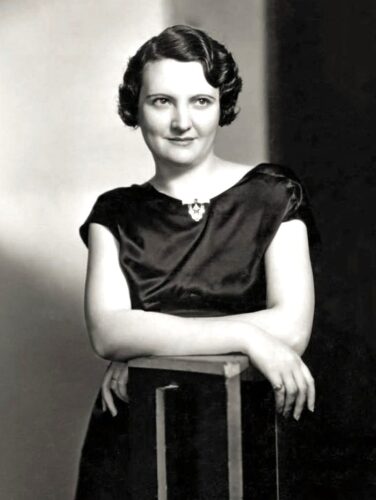
Costume designer Vera West was the very accomplished costume designer for Universal Pictures during its monster movies and film noir era. Her name is not as well-known as many from this Golden Age of Hollywood, yet she made all the Los Angeles newspapers when on June 26, 1947, she was discovered dead and floating in the pool behind her home at 5119 Bluebell Avenue in North Hollywood. Two notes were found by the police in her bedroom: “This is the only way. I am tired of being blackmailed,” and “The fortuneteller told me there was only one way to duck the blackmail I’ve paid for 23 years–death.” The notes were addressed to “Jack Chandler,” alias Jack or Jacques C. West, her husband. An empty bottle of sleeping pills was also found in the house. A tenant of the guest house, photographer Robert Landry, discovered the body of West when he noticed her dogs whimpering by the pool. Her husband was out of town. After the husband returned and was questioned, nothing was found to incriminate him. * But it seems odd that he had the custom-built house torn down and then sold the lot. Nothing was heard from Jack West again. **
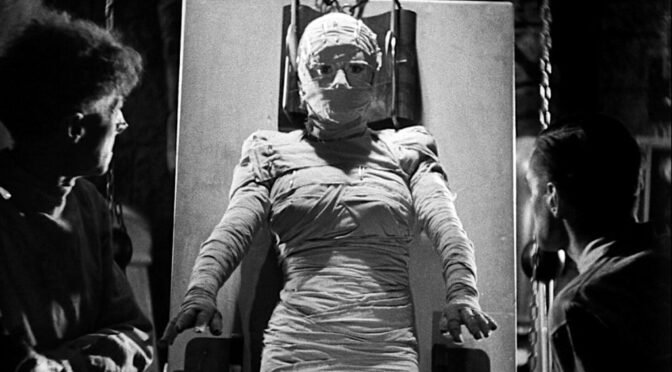
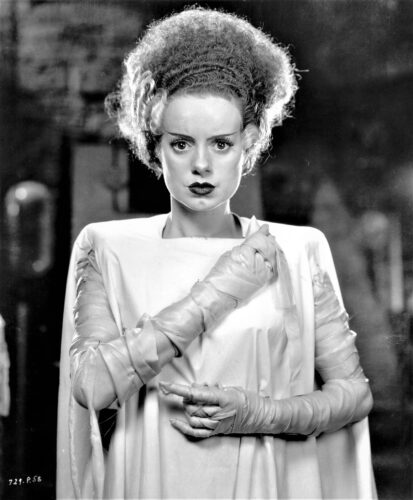
Vera West became Universal’s second costume designer in 1928, although she was not given screen credit for many of her early films. These included such classics as The Man Who Laughs (with David Cox); Dracula (1931); Back Street (1932); The Mummy (1932); The Black Cat, Show Boat, and The Bride of Frankenstein. For Elsa Lanchester in The Bride of Frankenstein (1935), as Frankenstein’s mate, West’s costume designs became an iconic image. The billowing white shroud-like dress with padded shoulders and shirred bandage sleeves has been an influence for horror queens for decades. Jack Pierce’s brilliant makeup and Lanchester’s wig with its white zig-zag bolt added to the effect. Lanchester was happier that West also dressed her in a beautiful gown when she played Mary Shelley in the film, embroidered with sequined stars, moons, and butterflies.
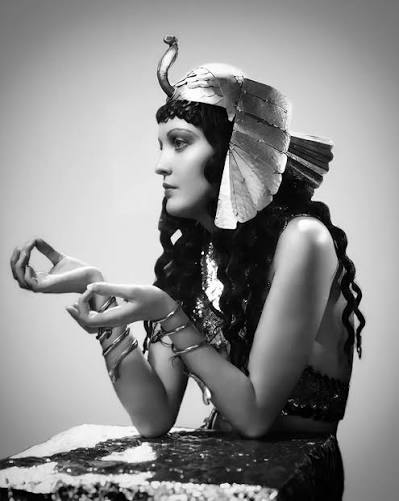
The prior year West had designed the gowns for Great Expectations, which starred twenty-four-year-old Jane Wyatt as Estella in her second film. Vera West dressed her in beautiful period costumes. Another one of West’s period films was the 1936 version of Universal’s musical, Show Boat. It was the last film produced under founder Carl Laemmle and was produced as a big-budget film. The film was based on Edna Ferber’s novel and the Florenz Ziegfeld Broadway musical. Songs and music were composed by Jerome Kern and Oscar Hammerstein II, with Irene Dunne, Allan Jones, and Paul Robeson. Although several costume designers were involved in costuming the big cast: Ed Brymer, Doris Zinkeisen, and the Western Costume Company, Vera West designed the wardrobe for star Irene Dunne. West’s designs for the turn-of the 20th-Century silhouette with its drapery and form-fitting torso was very becoming on Dunne, and her performance in this major musical film made Dunne a natural for more to come.
As the taste for monster movies waned, Universal was near bankrupt until the teenage Deanna Durbin made hits one after the other with her singing and acting talent. Vera West dressed her as the girl next door until she turned seventeen, then in First Love (1939), she finally dressed her in a ball gown embroidered in a sequined floral pattern for a scene where Durbin falls for her cousin’s boyfriend, played by Robert Stack. Vera West designed costumes for two other legends of the screen. For Marlene Dietrich in Destry Rides Again (1939), West dressed her in sexy saloon-girl costumes that showed off her legs. As Frenchy she sang “See What the Boys in the Back Room Will Have.” The song became a Dietrich trademark, later sung at her USO shows on the front in World War II and in her nightclub acts. The same saloon set used in Destry Rides Again, was used for My Little Chickadee (1940), where West designed costumes for Mae West. Vera West was able to design the flamboyant Gay Nineties-styled gowns that Mae West adored. But Mae West and costar W.C. Fields did not get along, and Fields walked off the set before the film wrapped.
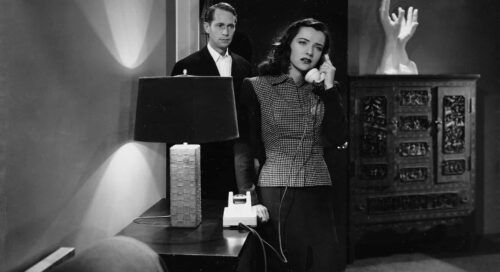
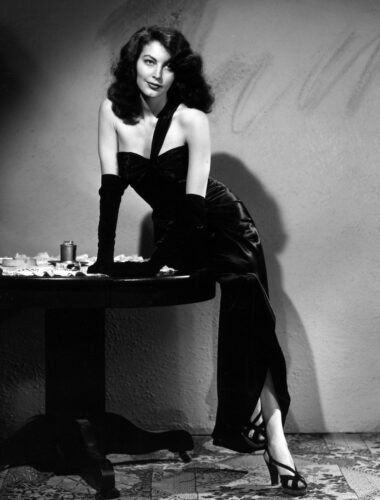
With the dark reality of World War II, film noir became a staple at many studios. An early Universal film noir was Phantom Lady (1944) produced by Joan Harrison, who had written screenplays for Alfred Hitchcock. Robert Siodmak directed, based on a story written by Cornell Woolrich under his pseudonym William Irish. Ella Raines starred, with Franchot Tone, Allan Curtis, Thomas Gomez, and the perpetual noir actor, Elisha Cook Jr. Vera West dressed Ella Raines in smart suits, office clothes, and gowns that made her stand out in every scene. A prominent wide-brimmed feather hat of the same design is worn by two women, which turns out to be a key plot element in the film. Another film noir made its lead cast famous, along with Vera West. Mark Hellinger at Universal produced one of the greatest of noirs, The Killers (1946). The film’s opening is based on a short story by Ernest Hemingway, with an uncredited screenplay by John Huston and Richard Brooks. Hellinger wanted unknowns for the leads, but the film made stars of Ava Gardner and Burt Lancaster in his first film. Since Ava Gardner was a relative unknown at the time, Vera West designed her wardrobe. In the process, the two created one of the iconic femme fatale looks in movie history. Ava Gardner wore a black satin gown with a single diagonal center strap, backless and with a slit in the front. The single strap was no doubt intended to cover her then-disallowed cleavage, but instead served as an arrow pointing it out. The pattern of her sexy cross-strap evening sandals was even echoed in the lining of her gown. West also dressed Ava in a great-looking trench coat and brimmed hat in her final scene.
West was finally assigned to dress one of the great stars of Hollywood – Claudette Colbert. She was surprised to learn that the film was The Egg and I (1947), the unglamorous story of a young married couple that moves from the city to the country to start a farm. Claudette Colbert and Fred MacMurray star, along with characters Ma and Pa Kettle played by Marjorie Main and Percy Kilbride. Colbert’s wardrobe quickly changed on the farm, from skirts and long-sleeved blouses to gingham dresses and pinafores. The movie was a big hit in 1947. But it was the last Universal film with costumes designed by Vera West, she resigned to start her own fashion line. After nearly twenty years with the studio, she left as she had started, with no film credit.
Getting costume designer jobs in Hollywood was always competitive in the late 1920s. The studios knew that film fashions as well as their costume designers marketed films. Not getting an on-screen film credit was common enough in the 1920s – even Travis Banton was seldom credited in those days. How did Vera West get her start?
West was born Vera Flounders on June 26, 1897 in Philadelphia, Pennsylvania. Her mother Lillian Flounders gave birth to Vera but was living with her parents William and Elizabeth Moore by the time Vera was three years old.*** Vera’s mother died at that time and her grandparents sent her to live with her father Emer Flounders and his new wife Clara, now her step-mother. Emer was a sheet metal worker that died in 1917, making Vera officially an orphan. In 1920 when Vera was twenty-two, she was still living with Clara and Clara’s daughter, although Vera was the bread-winner as a seamstress. **** Vera attended the Philadelphia School of Design for Women (now the Moore College of Art and Design), not to be confused with the Pennsylvania Academy of the Fine Arts. The art school Vera attended had as its mission to educate women for careers in the arts, with a vocational emphasis.
While Vera was still in Philadelphia, she met Stephen D. Kille, a short, heavy-set electrotyper. They dated and subsequently married on March 1, 1924. He gave her money to set up the household. But the marriage did not go well and she fled by July 21st. He filed a Debtor’s Attachment stating she had abandoned him and left the jurisdiction, owing him the balance of $467.50 (worth $9,130.38 in 2026 dollars), which was supposed to be spent on household furnishings. I found no records of Vera ever paying back her husband or ever getting a divorce from him. To avoid him she moved to New York, where she reportedly found work at the famous Lucile’s dressmaker’s salon on 57th Street, just off Fifth Avenue, once owned by the internationally known couturiere Lady Duff-Gordon. She was not there long before she hastily left for California, citing her experience working for Lady Duff-Gordon at Lucile’s to get her job at Universal in 1928, where she became head designer after Johanna Mathieson left in early 1930. Vera’s claim of having worked directly for Duff-Gordon, having been trained by her, or even having met her, is dubious. Duff-Gordon had sold her American branches in New York and Chicago when Vera was still in Philadelphia. And after WW I, Duff-Gordon stayed in either London or Paris through the mid-1920s, even as her sister wrote the screenplay for the movie It starring Clara Bow at Paramount. Duff-Gordon returned to London in 1923, where she remained, writing her memoirs.*****
Vera Flounders West had led a very tough life from infancy, learning to survive as an orphan and having to provide for herself and others. Along the way she picked up the habit of embroidering her life and dodging the past. The “blackmail” she referred to in her suicide note was most likely coming from her first husband, a resentful Stephen Kille, who was never repaid and never divorced. Vera West’s story became as fatale as any of the film noirs she worked on.
* “Designer Ends Life in Hollywood.” Hollywood UP, June 28, 1947.
** “Noted Woman Suicides Due to Blackmail.” San Jose Evening News. June 30, 1947.
*** Family Search, “Pennsylvania, Philadelphia, City Births, 1860-1915”, (https://www.familysearch.org/ark:/61903/1:1:V1MG-6LF
**** 1900, 1910, Census of the United States. Population, Philadelphia.
***** Bingham, Randy Bryan, Lucile: Her Life by Design. MacEvie Press, 2012.
This post is part of the Classic Movie Blog Association Fall Blogathon: Cinema Couture/The Art of Illusion. Check out the other fascinating entries.
For those readers who have subscribed to my blog, please know that I have purged my subscription list due to the very large numbers of bots. Please re-subscribe.
Views: 55


