M-G-M came late to producing its own cartoons. Walt Disney had built an entire studio around animation between 1923-1926, and Warner Bros. Cartoons was founded in 1932. Talented cartoonists made up a small colony in the Los Angeles of the early 1930s, and these three studios swapped several of the best over the formative years of the art.
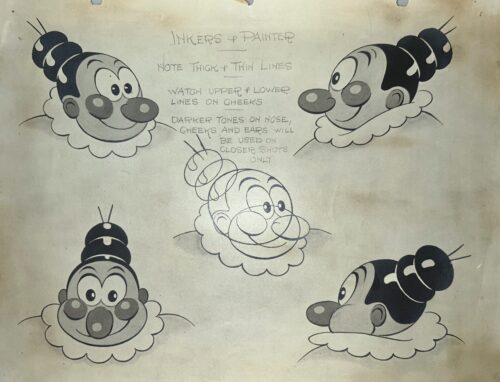
Prior to founding its own Cartoon Studio in 1937, M-G-M contracted with Ub Iwerks to produce its cartoons. He had been a top animator with Disney before operating as an independent. M-G-M also contracted with and distributed Hugh Harman’s and Rudolph Ising’s Happy Harmonies cartoons that had previously been part of the Disney stable. M-G-M found them so expensive that the studio decided to start its own studio. The job of managing the new department was given to Fred Quimby, one of M-G-M’s producers. Quimby then hired Harman and Ising to work for the new studio, along with Friz Freleng from Warner Bros. The studio then purchased the cartoon rights to the comic strip The Captain and the Kids from Rudolph Dirks. The latter was Dirks’ take-off of his original comic strip from 1897, The Katzenjammer Kids. Harman, Freleng and William “Bill” Hanna were slated to produce the new series.
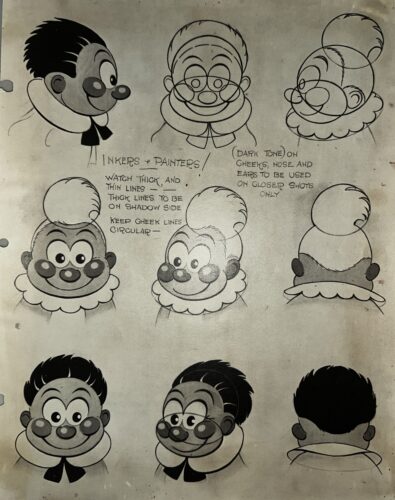
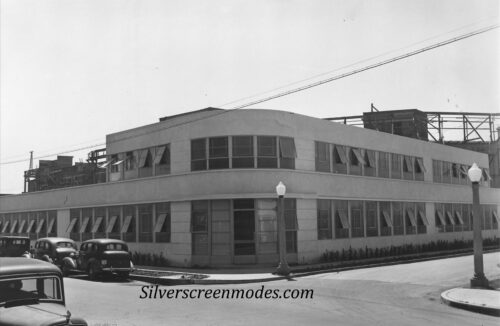
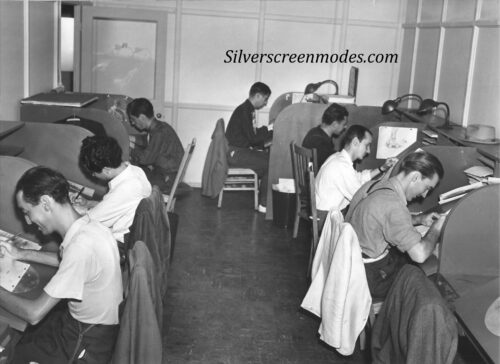
Hanna had come along as an employee of Harman/Icing. Several animators were hired for this new production, as well as the inkers, painters, sound effects technicians, cameramen, a composer, and others. A new building was opened on M-G-M’s Lot Two, facing Overland Blvd. and behind “Waterfront Street.” Despite these efforts, the cartoons still had to prove they could make money, and the cartoonists cubicles were small and bare bones.
In 1938, 15 short cartoons of Captain and the Kids were produced by Bill Hanna, Friz Freleng, and Bob Allen. Whereas the characters in the original comic strip were popular: the Captain, Mama, Hans and Fritz, and John Silver, among others, they never clicked as an animated cartoon. Moreover, none of the characters were created by the M-G-M animation staff. By year’s end, the cartoon series was terminated. Friz Freleng went back to Warner Bros., but the creative group of animators went back to work. Rudolph Ising came up with the character Barney Bear, starting in the cartoon The Bear Who Couldn’t Sleep, in 1939. Barney Bear portrayed a sleepy, lethargic bear. The other animators thought this was much like Rudy Ising’s own persona. Hugh Harman produced and directed Peace on Earth, a cartoon where only animals survived in a world devoid of humans due to war. The cartoon garnered Academy Award and Nobel Peace Prize nominations.
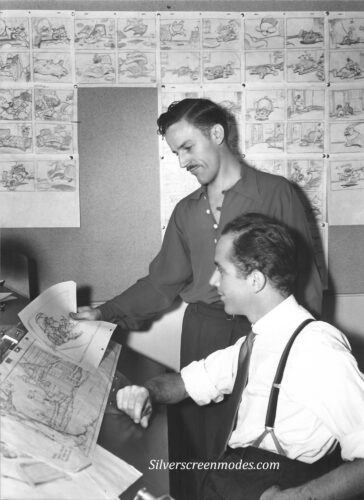
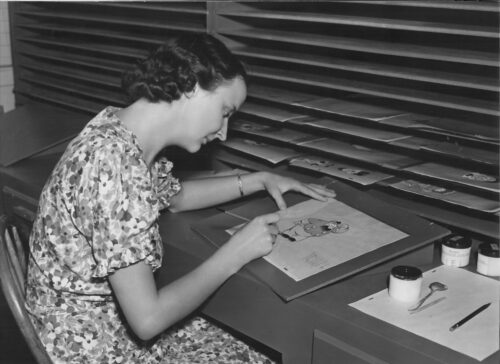
Two animators first met while working together on Captain and the Kids: Bill Hanna who was one of its producers, and Joe Barbera, a writer and cartoonist. In 1939 they came up with the idea of characters for a new cartoon: Tom and Jerry. The soon to be famous combative cat and mouse duo who made their first appearance in Puss Gets the Boot in 1940. The second Tom and Jerry cartoon, Midnight Snack, was released in July 1941 and revised the look of both Tom and Jerry. But hereafter, the diminutive Jerry would always get the better of Tom.
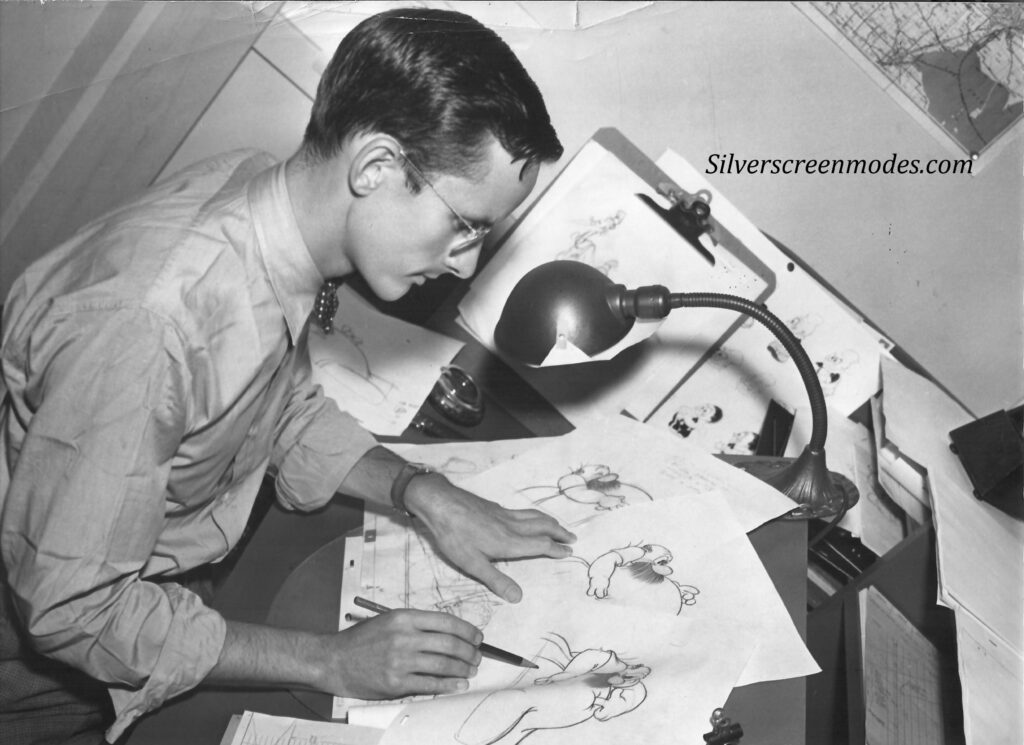
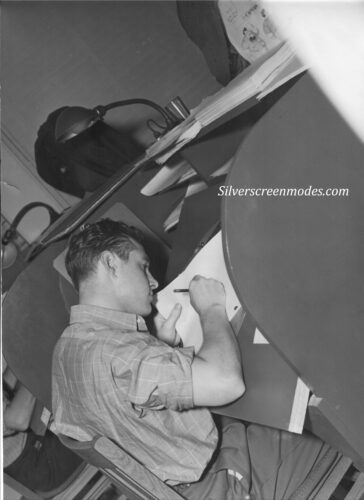
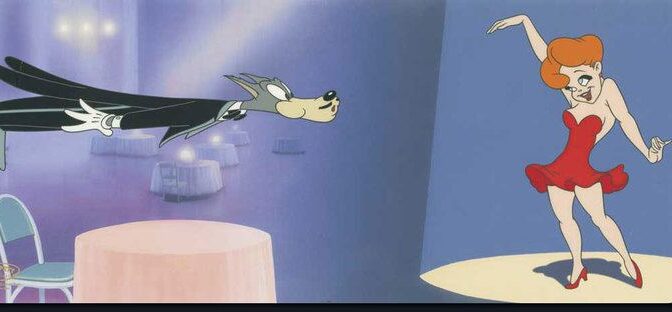
In August of 1941 Hugh Harman left M-G-M to start his own company. This loss was offset by the gain of Tex Avery, who came from Warner Bros. Avery was largely responsible for the creation of Bugs Bunny, Elmer Fudd, and Daffy Duck. His cartoon style was influenced by the antics of the Marx Brothers and other movie comedians, with the added freedom that cartoon animation could provide. At M-G-M, he let his taste for slapstick and absurdist actions enable his characters to defy the laws of physics and propriety, and the fourth wall. This was exemplified by his creation of Red Hot Riding Hood, and her pursuer the Wolf. Avery never gave a name to the Wolf, perhaps thinking it represented the baser instincts in every man. Red Hot Riding Hood and the Wolf made their introduction in 1943. It was voted number 7 in The 50 Greatest Cartoons: As Selected by 1,000 Animation Professionals, the 1994 book by animation historian Jerry Beck. That first cartoon can be watched at: https://www.dailymotion.com/video/x999yl4 During World War II, it was hugely popular with GIs. Avery took even more creative liberties with Northwest-Hounded Police, released in 1946 and featuring Wolf as an escaped convict being chased by Avery’s character Droopy (not yet named as such), In one scene, Wolf runs so fast his momentum carries him right off the edge of the sprocketed film. In another, Wolf is part of a movie theater audience when Droopy (as McPoodle) talks to him from the screen, and it all started with Woolf drawing himself out of prison.
Avery had started out in cartoons as an inker, and he was one of the only producers that regularly visited and talked with the inkers and painters. That glass ceiling had been broken (temporarily), when cartoon painter Jeanne Fuller was promoted to Hugh Harman’s writing staff based on her idea for the character Tom Turkey in 1939.
Red Hot Riding Hood went on to influence Jim Carrey’s 1994 movie The Mask. Several references are made to the cartoon, including Carrey’s character Stanley Ipkiss watching the cartoon in his apartment. And the first part of the Coco Bongo nightclub scene, where Jim Carrey’s character sees Cameron Diaz perform, it is a basic recreation of the Wolf’s reaction in the cartoon.
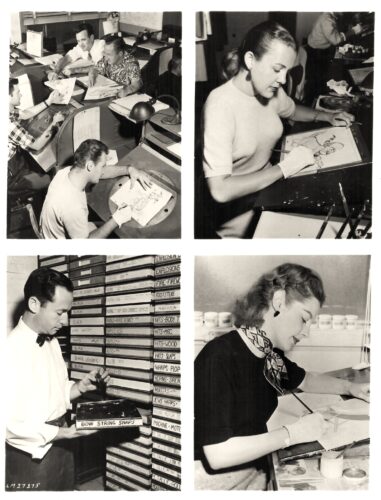
The photos above show the MGM Cartoon Studio in 1953, with various steps involved in the production of a Hanna-Barbera cartoon. From top left to right clockwise: these animators are called “inbetweeners,” drawing each stage of Tom in a jump from where the first animator started him off; the “inker” uses India ink to trace a cartoon on an individual cell; Sound Effects Technician Jim Faris searches for the right sound track for an archery scene; Painter Brooke Mitchell paints the watercolors on a cell previously inked.
The M-G-M Cartoon Studio continued producing successful cartoons. Avery created Droopy the white basset hound. Hanna and Barbera had Tom and Jerry integrated into the M-G-M movies, Anchors Aweigh, Dangerous When Wet, and Invitation to the Dance. Hanna and Barbera took over management of the Cartoon Department after Fred Quimby retired in 1955. Tex Avery had taken a leave of absence in 1950 from exhaustion. He returned a year later but was let go by Quimby in early 1953. By the late 1950s, the deterioration of movie studio profits due to the impact of television viewing at home caused reductions of staffing across the board. In 1957, Joe Barbera got a phone call from M-G-M management telling him to close down production and let everyone go, effective May 15. Future Academy Award winner Jack Nicholson, an office assistant at the cartoon studio, was one of its last employees. Hanna and Barbera started their own company and took many animators and others with them. Their future was television – and with the run of their characters and shows including Huckleberry Hound, Yogi Bear, and The Flintstones.
This blog post is part of the Classic Movie Blog Association’s “Make ‘Em Laugh,” Blogathon running from May 4-8. See below for other posts: https://clamba.blogspot.com/2026/03/announcing-cmba-spring-blogathon-make.html
Information resources include: https://tralfaz.blogspot.com/
https://metro-goldwyn-mayer-cartoons.fandom.com/wiki/MGM_Cartoons_Wiki
https://en.wikipedia.org/wiki/Main_Page
Views: 334
Hey Christian. ..
and Friz Frelang was Woody Woodpecker yes? Thanks for putting the link for Red. I laughed aloud several times. The length of the limo when Wolf first pulls up to the door…hahahaha Thanks for a fun end to the day!
Hi Cynthia. I’m glad you got a laugh out of Red and the Wolf. That Tex Avery cartoon series is really unique. You can look for more on the web. And yes, Freleng came up with Woody Woodpecker.
Christian,
This is a fantastic story. While I recognized some of the names, I was not familiar with this information. This is a great look at the early days not only of MGM cartoons, but also the work of artists including Tex Avery, Hannah and Barbera and how iconic characters like Droopy, Tom and Jerry were created. Thanks for sharing your knowledge. – Toni
Thanks Toni. This ealy period in cartooning history is not well known so I’m gratified that you were able to learn about some
of its history. I had wanted to do this post for a long time so the CMBA blogathon was a good opportunity.
I LOVED this article, as I’m a huge fan of classic cartoons and your article does such a fantastic job of detailing the history of MGM’s foray into animation. Of course those early years laid the groundwork for the legendary work of the likes of Tex Avery and others that was to come.
Thanks Paul, I’m glad you enjoyed my post.These early cartoons were really groundbreaking.
I used to have a DVD of so-called “censored” cartoons that had the Red Hot Riding Hood on it. I thought it was great.
I’m sure that was an interesting DVD. What I like about the Tex Avery cartoons is that they are geared towards adults. While I always enjoy watching a classic
Warner Bros. or Disney cartoon, those wild Tex Avery Wolf cartoons are so much fun.
Terrific post, Christian! I knew little of this history, and was amazed at the resource sharing among the different studios’ cartoon departments. I also love to see the women highlighted. Not having been a big fan of animated film, I will check out some of these with the new knowledge of the people involved.
Thank you Jocelyn. Walt and Roy Disney started their cartoon productions in Kansas City and several cartoonists came from there as well when they moved to Los Angeles.
By then LA became a mecca. with the movie studios named in the blog competing for talent. It took a long time for all the studios to get over their sexist attitudes, whether in animation
or movies, but there is no doubt that women played an important role in the production of animation.
Thank you for sharing your research on this early animation studio. So much talent! Even though we have AI and all kinds of animation software today, nothing beats the old shorts for artistry – those were made with loving care.
Thanks for your comment Ruth. Yes, it was truly a Golden Age of cartoons when the studios vied for creativity, humor, and artistry.
This was a fascinating read! It’s amazing to see how much work there is behind an animated film. True works of art.
Thank you Virginie and I’m gratified that you enjoyed the post. I must say I much preferred the classic cartoons pre-1950s when they spent much more time and effort
in fully animating every move of the characters with full backgrounds. They were works of art indeed.
Splendid post, Christian! The photos and accompanying drawings were wonderful. I have to share this post with my cartoonist twin brother. I’ve always been a big fan of animated cartoons and feel they are an integral part of the study and history of classic film. This was a real treat.
Thank you Jacqueline. MGM’s involvement in cartoon production is not as well known but was still significant. Many of the individual cartoonists are not known
except by the aficionados although they were the ones that made it possible – similar to the scriptwriters, camera operators, costume designers and others in film.
I’m pleased you enjoyed the post.
I really must forward your post to my animator friend. This was a great read and I loved those photos.
Glad you enjoyed it Gill and hope your animator friends will too. I’ve had those photos of the cartoonists for years after acquiring a group of MGM
photos. I was finally able to do a blog post about them.
Very cool history Christian! I always love seeing behind the scenes photos and have always been fascinated by the many unsung people who brought these cartoons to life.
Thank you Shawn! I’m always fascinated by the crafts behind the scenes also, and it’s rare to see many of these cartoonists early in their careers. And working in such humble
quarters!
What a fascinating read, Christian. I was especially interested to learn about Red Hot Riding Hood influencing The Mask.
Maddy from Classic Film And TV Corner
Thanks Maddy! The earliest MGM cartoons are not memorable, but they led to greater things like Tom & Jerry and the wild cartoons of Tex Avery.